MCQ
If the temperature of a uniform rod is slightly increased by ∆t, its moment of inertia Iabout a line parallel to itself will increase by:
  • A
    $\text{Zero}$
  • B
    $\alpha\text{I}\Delta\text{t}$
  • $2\alpha\text{I}\Delta\text{t}$
  • D
    $3\alpha\text{I}\Delta\text{t}$

Answer

Correct option: C.
$2\alpha\text{I}\Delta\text{t}$
The moment of inertia of a solid body of any shape changes with temperature as
$\text{I}'=\text{I}(1+2\alpha\Delta\text{t})$
Here, I = initial moment of inertia
I' = new moment of inertia due to change in temperature
$\alpha=\text{expansion coefficient}$
$\Delta\text{t}=\text{change in temperature}$
$\text{So},\text{I}'-\text{I}=2\alpha\text{I}\Delta\text{t}$

Need a full question paper?

Generate a complete, print-ready paper with questions like this in minutes — across 16+ boards, with answer keys.

Start Generating Free

Similar questions

if Energy is given by $U = \frac{{A\sqrt x }}{{{x^2} + B}},\,$, then dimensions of $AB$ is
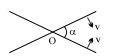
Find the speed of the intersection point $O$ of the two wires if the wires starts moving perpendicular to itself with speed $v$ as shown in figure.
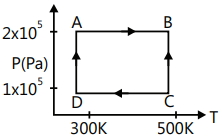
Two moles of helium gas are taken over the cycle $ABCDA$, as shown in the $P-T$ diagram. Assuming the gas to be ideal the work done on the gas in taking it from $A $ to $B$ is ...... $R$
For a reversible process, necessary condition is
A bar magnet is released from rest along the axis of a very long, vertical copper tube. After some time the magnet:
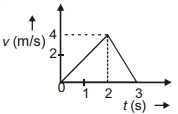
The velocity versus time graph of a body moving in a straight line is as shown in the figure below
Escape velocity on earth is $11.2\, km/s$. What would be the escape velocity on a planet whose mass is $1000$ times and radius is $10$ times that of earth ......... $km/sec$​
Trajectory of particle in a projectile motion is given as $y=x-\frac{x^2}{80}$. Here, $x$ and $y$ are in metre. For this projectile motion match the following with $g=10\,m / s ^2$.
$Column-I$ $Column-II$
$(A)$ Angle of projection $(p)$ $20\,m$
$(B)$ Angle of velocity with horizontal after $4\,s$ $(q)$ $80\,m$
$(C)$ Maximum height $(r)$ $45^{\circ}$
$(D)$ Horizontal range $(s)$ $\tan ^{-1}\left(\frac{1}{2}\right)$
The $S.H.M.$ of a particle is given by the equations $=2 \sin \omega t+4 \cos \omega t$. Its amplitude of oscillation is ........ units
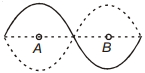
In the standing wave shown, particles at the positions $A$ and $B$ have a phase difference of