Question
If the total surface area of a solid hemisphere is 462cm, find its volume.

Answer

Total surface area of solid hemisphere $=3\pi\text{r}^2$
$\Rightarrow462=3\pi\text{r}^2$
$\Rightarrow462=3\times\frac{22}{7}\times\text{r}^2$
$\Rightarrow462=\frac{66}{7}\times\text{r}^2$
$\Rightarrow\text{r}^2=\frac{3234}{66}$
$\Rightarrow\text{r}^2=49$
$\Rightarrow\text{r}=7\text{cm}$
Now,
Volume of a solid hemisphere $=\frac{2}{3}\pi\text{r}^3$
$=\frac{2}{3}\times\frac{22}{7}\times7\times7\times7$
$=\frac{2156}{3}$
$=718.67\text{cm}^3$

Need a full question paper?

Generate a complete, print-ready paper with questions like this in minutes — across 16+ boards, with answer keys.
Start Generating Free

Similar questions

A committee of two members is to be formed from three boys and two girls. Find the probability of the following events :
Event A : At least one girl must be a member of the committee.
Event B : Committee must be of one boy and one girl.
In a $\triangle\text{ABC,D}\ \text{and E}$ are points on the sides AB and AC respectively such that DE || BC.
If $\frac{\text{AD}}{\text{DB}}=\frac{2}{3}$ and AC = 18cm, find AE.
In which of the following situations, the sequence of numbers formed will form an A.P.?
The amount of air present in the cylinder when a vacuum pump removes each time $\frac{1}{4}$ of the remaining in the cylinder.
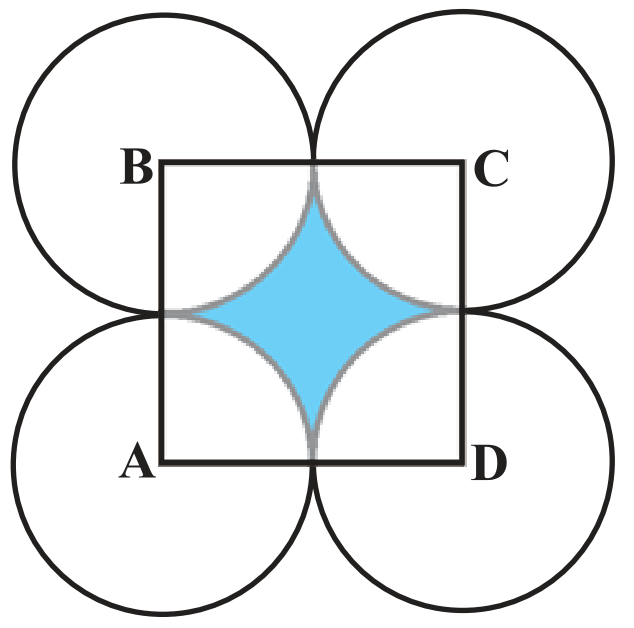
In the given figure, points A, B, C and D are the centres of four circles that each have a radius of length one unit. If a point is selected at random from the interior of square ABCD. What is the probability that the point will be chosen from the shaded region.

Evaluate the following:
If A and B are acute angle such that $\tan\text{A}=\frac13,\tan\text{B}=\frac12$ and $\tan(\text{A}+\text{B})=\frac{\tan\text{A}+\tan\text{B}}{1-\tan\text{A}\tan\text{B}},$ show that $\text{A}+\text{B}=45^\circ.$
If A (-14, -10), B(6, -2) is given, find the coordinates of the points whichdivide segment AB into four equal parts.
If $\text{cosec }\theta=2\text{x and }\cot\theta=\frac{2}{\text{x}},$ find is the value of $2\Big(\text{x}^2-\frac{1}{\text{x}^2}\Big)$.
Solve the following systems of equations:
$\frac{2}{\text{x}}+\frac{5}{\text{y}}=1,$
$\frac{60}{\text{x}}+\frac{40}{\text{y}}=19,\text{x}\neq0,\text{y}\neq0.$
The sum of two numbers is $8$ and $15$ times the sum of their reciprocals is also $8$. Find the numbers.
Which of the following sequences are arithmetic progressions. For those which are arithmetic progressions, find out the common difference.
$\frac{1}{2},\frac{1}{4},\frac{1}{6},\frac{1}{8}, .....$