MCQ
If the vectors $3\hat{\text{i}}+\lambda\hat{\text{j}}+\hat{\text{k}}$ and $2\hat{\text{i}}-\hat{\text{j}}+8\hat{\text{k}}$ are perpendicular, then $\lambda$ is equal to:
  • A
    $-14$
  • B
    $7$
  • $14$
  • D
    $\frac{1}{7}$

Answer

Correct option: C.
$14$
It is given that vectors $3\hat{\text{i}}+\lambda\hat{\text{j}}+\hat{\text{k}}$ and $2\hat{\text{i}}-\hat{\text{j}}+8\hat{\text{k}}$ are perpendicular.
So, their dot product is zero.
$\big(3\hat{\text{i}}+\lambda\hat{\text{j}}+\hat{\text{k}}\big).\big(2\hat{\text{i}}-\hat{\text{j}}+8\hat{\text{k}}\big)=0$
$\Rightarrow6-\lambda+8=0$
$\Rightarrow14-\lambda=0$
$\therefore\lambda=14$

Need a full question paper?

Generate a complete, print-ready paper with questions like this in minutes — across 16+ boards, with answer keys.
Start Generating Free

Similar questions

Consider the following statements in respect of the differential equation $\frac{\text{d}^2\text{y}}{\text{d}\text{x}^2}+\cos\Big(\frac{\text{dx}}{\text{dy}}\Big)=0:$
$1.$ The degree of the differential equation is not defined.
$2.$ The order of the differential equation is $2.$
Which of the above statements is/are correct ?
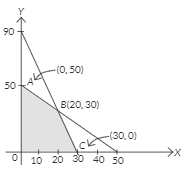
The maximum value of $Z=4 x+y$ for a $\text{L.P.P.}$ whose feasible region is given below is:
Image
Inverse of matrix $X=\left[\begin{array}{lll}2 & 0 & 0 \\ 0 & 3 & 0 \\ 0 & 0 & 4\end{array}\right]$ is :
Solution of the equation $({e^x} + 1)ydy = (y + 1){e^x}dx$ is
If vectors $(\text{x}-2)\ \vec{\text{a}}+\vec{\text{b}}$ and $(2\text{x}+1)\ \vec{\text{a}}-\vec{\text{b}}$ are parallel then $x:$
The value of $\int \limits_{0}^{\pi} \frac{e^{\cos x} \sin x}{\left(1+\cos ^{2} x\right)\left(e^{\cos x}+e^{-\cos x}\right)} d x$ is equal to
$\frac{d}{{dx}}\left( {{a^{{{\log }_{10}}{\rm{cose}}{{\rm{c}}^{ - 1}}x}}} \right)$=
Number of points of local maxima and minima of $f(x) = |x^2 - 2|x||$ in $R$, are $M$ and $m$ respectively, then value of $2M + m$ is -
Let $A=\left[\begin{array}{ccc}2 & 1 & 0 \\ 1 & 2 & -1 \\ 0 & -1 & 2\end{array}\right]$. If $|\operatorname{adj}(\operatorname{adj}(\operatorname{adj} 2 A))|=(16)^{ n }$, then $n$ is equal to
The corner points of the feasible region determined by the system of linear inequalities are (0, 0), (4, 0), (2, 4) and (0, 5). If the maximum value of z = ax + by, where a, b > 0 occurs at both (2, 4) and (4, 0), then: