Question
If the velocity of light (c), the constant of gravitation (G) and Planck's constant (h) be chosen as the fundamental units, find the dimensions of mass, length and time in the new system.

Answer

Let us write the dimensions of c, G and h in terms of M, L and T. $\text{Let}\text{M}=\text{Kc}^a\text{G}^b\text{h}^\text{y},$ where K is constant $\text{[M]}=\text{[LT}^{-1}]^\alpha\text{[M}^{-1}\text{[L}^3\text{T}^{-2}]^\beta\text{[ML}^2\text{T}^{-1}]^\gamma$ $=\text{[M}^{-\beta+\gamma}\text{L}^{\alpha+3\beta+2\gamma}\text{T}^{-\alpha-2\gamma}]$ Comparing the powers of M, L and T on both the sides, we have: $-\beta+\gamma=1$ $\alpha+3\beta+2\gamma=0$ $-\alpha-2\beta-\gamma=0$ Solving these equations, we get, $\alpha=\frac{1}{2},\beta=\frac{-1}{2},\gamma=\frac{1}{2}$ $\therefore \text{M}=\text{Kc}^\frac{1}{2}\text{G}^\frac{1}{2}\text{h}^\frac{1}{2}$ Taking$\text{K}=\text{I},$ we can write $\text{M}=_\text{c}^\frac{1}{2}\text{G}^{\frac{-1}{2}}\text{h}^\frac{1}{2}$ Similary,we can prove that. $\text{L}=_\text{c}^\frac{-3}{2}\text{G}^\frac{1}{2}\text{h}^\frac{1}{2}$ $\text{T}=_\text{c}^\frac{-5}{2}\text{h}^\frac{1}{2}\text{G}^\frac{1}{2}$

Need a full question paper?

Generate a complete, print-ready paper with questions like this in minutes — across 16+ boards, with answer keys.
Start Generating Free

Similar questions

A body of mass 3kg makes an elastic collision with anthor body at rest and continues to move in the original direction with a speed equal to one-third of its original speed. Find the mass of the second body.
Find the greatest length of steel wire that can hang vertically without breaking. Breaking stress of steel = $8.0 \times 10^8Nm^{-2}$, density of steel = $8.0 \times 10^3kg/ m^{-3} and g = 10ms^{-2}$.
A man can swim with a speed of $4.0km/h$ in still water. How long does he take to cross a river $1.0km$ wide if the river flows steadily at $3.0km/h$ and he makes his strokes normal to the river current? How far down the river does he go when he reaches the other bank?
A motor boat covers the distance between two spots on the river in time of 8 hours and 12 hours downstream and upstream respectively. What is the time required for the boat to cover this distance in still water?
Pick out the two scalar quantities in the following list: force, angular momentum, work, current, linear momentum, electric field, average velocity, magnetic moment, relative velocity.
Let AE denote the energy gap between the valence band and the conduction band. The population of conduction electrons (and of the holes) is roughly proportional to $\text{e}^{\frac{-\Delta\text{E}}{2\text{kT}}}.$ Find the ratio of the concentration of condu.ction electrons in diamond to that in silicon at room temperature 300K. $\Delta\text{E}$ for silicon is 1.1eV and for diamond is 6.0eV. How many conduction electrons are likely to be in one cubic metre of diamond?
As you have learnt in the text, a geostationary satellite orbits the earth at a height of nearly $36,000km$ from the surface of the earth. What is the potential due to earth’s gravity at the site of this satellite? (Take the potential energy at infinity to be zero). Mass of the earth = $6.0 \times 10^{24}kg$, radius = $6400km$.
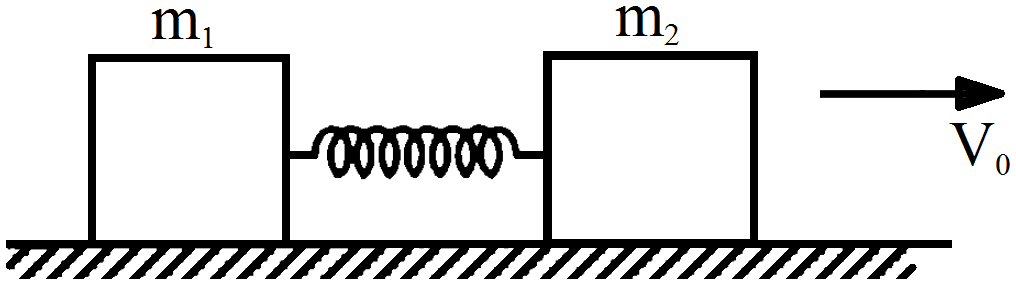
Two blocks of masses $m_1$ and $m_2$ are connected by a spring of spring constant k. The block of mass $m_2$ is given a sharp impulse so that it acquires a velocity $v_0$ towards right. Find
  1. The velocity of the centre of mass.
  2. The maximum elongation that the spring will suffer.
​​​​​​​
A wheel starting from rest is uniformly accelerated at $4 rad/-s^2$ for $10$ seconds.It is allowed to rotate uniformly for the next $10$ seconds and is finally brought to rest in the next 10 seconds. Find the total angle rotated by the wheel.
A steel wire has a length of $12.0m$ and a mass of $2.10kg$. What should be the tension in the wire so that speed of a transverse wave on the wire equals the speed of sound in dry air at $20^\circ C = 343m s^{–1}$.