MCQ
If the vertices of a triangle have integral coordinates, then the triangle is
  • A
    Equilateral
  • Never equilateral
  • C
    Isosceles
  • D
    None of these

Answer

Correct option: B.
Never equilateral
b
(b) Let and be the coordinates of the vertices of a triangle and let be all integers. Then the area of triangle
= Some rational numbers, because $x’s$ and $y's$ are integers.
Also, if the triangle is equilateral and a be the length of its side, then ${a^2} = {({x_1} - {x_2})^2} + {({y_1} - {y_2})^2} =  A$ positive integer.

The area of the triangle $ = \frac{1}{2}bc\,\,\sin A$ $ = \frac{1}{2}.\,a\,.\,a\,\sin {60^o} = \frac{{\sqrt 3 }}{4}{a^2}$every angle is of ${60^o}\} $
Which is irrationals, because ${a^2}$ is positive integer.

But earlier we have calculated that the area of the triangle is rational number. Hence it is a contradiction. Therefore, if the vertices of a triangle are integers, the triangle cannot be equilateral.
Note : Students should remember this question as a fact.

Need a full question paper?

Generate a complete, print-ready paper with questions like this in minutes — across 16+ boards, with answer keys.
Start Generating Free

Similar questions

Let $A=\left[a_{i j}\right]$ be a square matrix of order $3$ such that $a_{i j}=2^{j-i}$, for all $i, j=1,2,3$. Then, the matrix $A ^{2}+ A ^{3}+\ldots+ A ^{10}$ is equal to
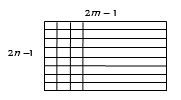
There is a rectangular sheet of dimension $(2m - 1) × (2n - 1)$, (where $m > 0,n > 0)$. It has been divided into square of unit area by drawing lines perpendicular to the sides. Find number of rectangles having sides of odd unit length
If $\frac{{c + i}}{{c - i}} = a + ib$, where $a,b,c$are real, then ${a^2} + {b^2} = $
The solution of the differential equation $(1 + {x^2})(1 + y)dy + (1 + x)(1 + {y^2})dx = 0$ is
Point of intersection of the diagonals of square is at origin and coordinate axis are drawn along the diagonals. If the side is of length $a$, then one which is not the vertex of square is
A stair-case of length $l$ rests against a vertical wall and a floor of a room. Let $P$ be a point on the stair-case, nearer to its end on the wall, that divides its length in the ratio $1 : 2$. If the staircase begins to slide on the floor, then the locus of $P$ is
If the point $P$ on the curve, $4 x^{2}+5 y^{2}=20$ is farthest from the point $Q (0,-4),$ then $PQ ^{2}$ is equal to 
If $a = 3i - j + 2k,$ $b = 2i + j - k,$ then $a \times (a\,.\,b) = $
If the system of linear equations $2 x+3 y-z=-2$  ; $x+y+z=4$  ; $x-y+|\lambda| z=4 \lambda-4$  (where $\lambda \in R$), has no solution, then
A wire of length $20 m$ is to be cut into two pieces. A piece of length $\ell_1$ is bent to make a square of area $A_1$ and the other piece of length $\ell_2$ is made into a circle of area $A _2$. If $2 A _1+3 A _2$ is minimum then $\left(\pi \ell_1\right): \ell_2$ is equal to: