MCQ
If the volume of parallelepiped formed by the vectors $\hat i + \lambda \hat j + \hat k$, $\hat j + \lambda \hat k$ and $\lambda \hat i + \hat k$ is minimum, then $\lambda $ is equal to
  • A
    $\sqrt 3 $
  • B
    $\frac{1}{{\sqrt 3 }}$
  • C
    $-\frac{1}{{\sqrt 3 }}$
  • None of these

Answer

Correct option: D.
None of these
d
Volume of paralleopiped $ = \left\| {\begin{array}{*{20}{l}}
1&\lambda &1\\
0&1&\lambda \\
\lambda &0&1
\end{array}} \right\|$

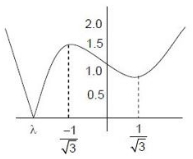
$f(\lambda)=\left|\lambda^{3}-\lambda+1\right|$

Its graphs as follows

where $\lambda=-1.32$

For minimum value of volume of paralelopiped and corresponding value of $\lambda$; the minimum value is zero, $\because$ cubic always has at least one real root.

Hence answer to the question must be root of cubic $\lambda^{3}-\lambda+1=0 .$ None of the options satisfies the cubic.

Hence Question must be Bonus.

Need a full question paper?

Generate a complete, print-ready paper with questions like this in minutes — across 16+ boards, with answer keys.

Start Generating Free

Similar questions

In the mean value theorem, $f(b) - f(a) = (b - a)f'(c)$if $a = 4$, $b = 9$ and $f(x) = \sqrt x $ then the value of  $c$  is
If $A = \left[ {\begin{array}{*{20}{c}}1&a\\0&1\end{array}} \right]$, then ${A^4}$ is equal to
If $\frac{d}{{dx}}\,G\left( x \right) = \frac{{{e^{\tan \,x}}}}{x},\,x \in \left( {0,\pi /2} \right)$, then $\int\limits_{1/4}^{1/2} {\frac{2}{x}} .{e^{\tan \,\left( {\pi \,{x^2}} \right)}}dx$ is equal to
The number of elements in the set $S=\left\{x \in R : 2 \cos \left(\frac{x^{2}+x}{6}\right)=4^{x}+4^{-x}\right\}$ is$.....$
If the inequality $kx^2 -2x + k \geq  0$ holds good for atleast one real $'x'$ , then the complete set of values of $'k'$ is
If $\mathop {\lim }\limits_{x \to 2} \frac{{{x^n} - {2^n}}}{{x - 2}} = 80$, where $n$ is a positive integer, then $n = $
Let $\vec{a}=4 \hat{i}-\hat{j}+\hat{k}, \vec{b}=11 \hat{i}-\hat{j}+\hat{k}$ and $\vec{c}$ be a vector such that $(\vec{a}+\vec{b}) \times \vec{c}=\vec{c} \times(-2 \vec{a}+3 \vec{b}) \text {. }$

If $(2 \vec{a}+3 \vec{b}) \cdot \vec{c}=1670$, then $|\vec{c}|^2$ is equal to :

The number of permutations, of the digits $1,2,3,...7$ without repetition, which neither contain the string $153$ nor the string $2467$, is $........$.
Let $\mathrm{Y}=\mathrm{Y}(\mathrm{X})$ be a curve lying in the first quadrant such that the area enclosed by the line $Y-y=Y^{\prime}(x)(X-x)$ and the co-ordinate axes, where $(\mathrm{x}, \mathrm{y})$ is any point on the curve, is always $\frac{-y^2}{2 Y^{\prime}(x)}+1, Y^{\prime}(x) \neq 0$. If $Y(1)=1$, then $12 Y(2)$ equals
The equation ${y^2} - {x^2} + 2x - 1 = 0$ represents