Question
If there is a statement involving the natural number n such that:
  1. The statement is true for n = 1
  2. When the statement is true for n = k (where k is some positive integer), then the statement is also true for n = k + 1.
Then, the statement is true for all natural numbers n.
Also, if A is a square matrix of order n, then A2 is defined as AA. In general, Am = AA .... A (m times). where m is any positive integer.
Based on the above information, answer the following questions.
  1. If $\text{A}=\begin{bmatrix}3&-4\\1&-1\end{bmatrix},$ then for any positive integer n,
  1. $\text{A}^\text{n}=\begin{bmatrix}3\text{n}&-4\text{n}\\\text{n}&-\text{n}\end{bmatrix}$
  2. $\text{A}^\text{n}=\begin{bmatrix}1+2\text{n}&-4\text{n}\\\text{n}&1-2\text{n}\end{bmatrix}$
  3. $\text{A}^\text{n}=\begin{bmatrix}3\text{n}&-8\text{n}\\1&-\text{n}\end{bmatrix}$
  4. $\text{A}^\text{n}=\begin{bmatrix}1+3\text{n}&-4\text{n}\\\text{n}&1-3\text{n}\end{bmatrix}$
  1. If $\text{A}=\begin{bmatrix}1&2\\0&1\end{bmatrix},$ then |An|, where $\text{n}\in\text{ N},$ is equal to:
  1. 2n
  2. 3n
  3. n
  4. 1
  1. If $\text{A}=\begin{bmatrix}1&0\\1&1\end{bmatrix}$ and $\text{I}=\begin{bmatrix}1&0\\0&1\end{bmatrix}$ then which of the following holds for all natural numbers $\text{n}\geq1?$
  1. A= nA - (n - 1)I
  2. An = 2n-1 A - (n - 1)I
  3. A= nA + (n - 1)I
  4. An = 2n-1 A + (n - 1)I
  1. Let $\text{A}=\begin{bmatrix}\text{a}&0&0\\0&\text{a}&0\\0&0&\text{a}\end{bmatrix}$ and $\text{A}^\text{n}=[\text{a}_{\text{ij}}]_{3\times3}$ for some positive integer n, then the cofactor of a13 is:
  1. an
  2. -an
  3. 2an
  4. 0
  1. If A is a square matrix such that |A| = 2, then for any positive integer n, |An| is equal to:
  1. 0
  2. 2n
  3. 2n
  4. n2

Answer

  1. (b) $\text{A}^\text{n}=\begin{bmatrix}1+2\text{n}&-4\text{n}\\\text{n}&1-2\text{n}\end{bmatrix}$

Solution:

We have, $\text{A}=\begin{bmatrix}3&-4\\1&-1\end{bmatrix}$

$\therefore\text{A}^2=\begin{bmatrix}3&-4\\1&-1\end{bmatrix}\begin{bmatrix}3&-4\\1&-1\end{bmatrix}=\begin{bmatrix}5&-8\\2&-3\end{bmatrix},$ which can be obtained from $\text{A}^\text{n}=\begin{bmatrix}1+2\text{n}&-4\text{n}\\\text{n}&1-2\text{n}\end{bmatrix}$ for n = 2.

  1. (d) 1

Solution:

We have, $\text{A}=\begin{bmatrix}1&2\\0&1\end{bmatrix}$

$\therefore|\text{A}|=\begin{vmatrix}1&2\\0&1\end{vmatrix}=1-0=1$

Also, |An| = |A· A ...... A(n times)| = |A|n = 1n = 1

  1. (a) A= nA - (n - 1)I

Solution:

For n = 1, all options are true.

$\text{A}^2=\text{A}\cdot\text{A}=\begin{bmatrix}1&0\\1&1\end{bmatrix}\begin{bmatrix}1&0\\1&1\end{bmatrix}=\begin{bmatrix}1&0\\2&1\end{bmatrix}$

and $\text{A}^3=\text{A}^2\cdot\text{A}=\begin{bmatrix}1&0\\2&1\end{bmatrix}\begin{bmatrix}1&0\\1&1\end{bmatrix}=\begin{bmatrix}1&0\\3&1\end{bmatrix}$

Putting n = 3, in (a), we get A3 = 3A - 2I

$=3\begin{bmatrix}1&0\\1&1\end{bmatrix}-\begin{bmatrix}2&0\\0&2\end{bmatrix}$

$=\begin{bmatrix}3&0\\3&3\end{bmatrix}-\begin{bmatrix}2&0\\0&2\end{bmatrix}=\begin{bmatrix}1&0\\3&1\end{bmatrix},$ which is true.

All other options are different from A3 = 3A -2I for n = 3.

  1. (d) 0

Solution:

We have, $\text{A}=\begin{bmatrix}\text{a}&0&0\\0&\text{a}&0\\0&0&\text{a}\end{bmatrix}$

$\therefore\text{A}^2=\text{A}\cdot\text{A}=\begin{bmatrix}\text{a}&0&0\\0&\text{a}&0\\0&0&\text{a}\end{bmatrix}\begin{bmatrix}\text{a}&0&0\\0&\text{a}&0\\0&0&\text{a}\end{bmatrix}$

$=\begin{bmatrix}\text{a}^2&0&0\\0&\text{a}^2&0\\0&0&\text{a}^2\end{bmatrix}$

Similarly, $\text{A}^\text{n}=\begin{bmatrix}\text{a}^\text{n}&0&0\\0&\text{a}^\text{n}&0\\0&0&\text{a}^\text{n}\end{bmatrix}$

Now, cofactor of $\text{a}_{13}=(-1)^{1+3}\begin{vmatrix}0&\text{a}^\text{n}\\0&0\end{vmatrix}=0$

  1. (c) 2n

Solution:

We have, |A| = 2 and |An| = |A·A ...... A(n - times)|

= |A| |A| ...... |A|(n - times) = |A|n = 2n

Need a full question paper?

Generate a complete, print-ready paper with questions like this in minutes — across 16+ boards, with answer keys.

Start Generating Free

Similar questions

A rumour on whatsapp spreads in a population of 5000 people at a rate proportional to the product of the number of people who have heard it and the number of people who have not. Also, it is given that 100 people initiate the rumour and a total of 500 people know the rumour after 2 days.

Based on the above information, answer the following questions.
  1. If y(t) denote the number of people who know the rumour at an instant t, then maximum value of y(t) is:
  1. 500
  2. 100
  3. 5000
  4. None of these
  1. $\frac{\text{dn}}{\text{dt}}$ is proportional to:
  1. (y - 5000)
  2. y(y - 500)
  3. y(500 - y)
  4. y(5000 - y)
  1. The value of y(0) is:
  1. 100
  2. 500
  3. 600
  4. 200
  1. The value of y(2) is:
  1. 100
  2. 500
  3. 600
  4. 200
  1. The value of y at any time t is given by:
  1. $\text{y}=\frac{5000}{_\text{e}-5000\text{kt}_{+1}}$
  2. $\text{y}=\frac{5000}{_\text{1+e}-5000\text{kt}}$
  3. $\text{y}=\frac{5000}{_\text{49e}-5000\text{kt}_{+1}}$
  4. $\text{y}=\frac{5000}{_\text{49}{(_\text{1+e}}-5000\text{kt})}$
Read the following passage and answer the questions given below: In an Office three employees James, Sophia and Oliver process incoming copies of a certain form. James processes 50%of the forms, Sophia processes 20%and Oliver the remaining 30%of the forms. James has an error rate of0.06, Sophia has an error rate of 0.04 and Oliver has an error rate of0.03. Based on the above information, answer the following questions.

Image

(i) Find the probability that Sophia processed the form and committed an error.
(ii) Find the total probability of committing an error in processing the form.
(iii) The manager of the Company wants to do a quality check. During inspection, he selects a form at random from the days output of processed form. If the form selected at random has an error, find the probability that the form is not processed by James.
OR
(iii) Let E be the event of committing an error in processing the form and let 12 ,EEand 3 Ebe the events that James, Sophia and Oliver processed the form. Find the value of$\sum_{i=1}^3 P\left(E_i \mid E\right)$

Two motorcycles A and Bare running at the speed more than allowed speed on the road along the lines $\vec{\text{r}}=\lambda(\hat{\text{i}}+2\hat{\text{j}}-\hat{\text{k}})$ and $\vec{\text{r}}=3\hat{\text{i}}+3\hat{\text{j}}+\mu(2\hat{\text{i}+\hat{\text{j}}+\hat{\text{k}}}),$ respectively.

Based on the above information, answer the following questions.
  1. The cartesian equation of the line along which motorcycle A is running is:
  1. $\frac{\text{x}+1}{1}=\frac{\text{y}+1}{2}=\frac{\text{z}-1}{-1}$

  2. $\frac{\text{x}}{1}=\frac{\text{y}}{2}=\frac{\text{z}}{-1}$

  3. $\frac{\text{x}}{1}=\frac{\text{y}}{2}=\frac{\text{z}}{1}$

  4. None of these
  1. The direction cosines of line along which motorcycle A is running, are:
  1. < 1, -2, 1 >
  2. < I, 2, -1 >
  3. $<\frac{1}{\sqrt{6}},\frac{-2}{\sqrt{6}},\frac{1}{\sqrt{6}}>$

  4. $<\frac{1}{\sqrt{6}},\frac{2}{\sqrt{6}},\frac{-1}{\sqrt{6}}>$

  1. The direction ratios of line along which motorcycle Bis running, are:
  1. < 1, 0, 2 >
  2. < 2, 1, 0 >
  3. < 1, 1, 2 >
  4. < 2, 1, 1 >
  1. The shortest distance between the gives lines is:
  1. 4 units
  2. $2\sqrt{3}\text{ units}$

  3. $3\sqrt{2}\text{ units}$

  4. 0 units
  1. The motorcycles will meet with an accident at the point:
  1. (-1, 1, 2)
  2. (2, 1, -1)
  3. (1, 2, -1)
  4. Does not exist
An architecture design a auditorium for a school for its cultural activities. The floor of the auditorium is rectangular in shape and has a fixed perimeter P.

Based on the above information, answer the following questions.
  1. If x and y represents the length and breadth of the rectangular region, then relation between the variable is.
  1. x + y = P
  2. x2 + y2 = P2
  3. 2(x + y) = P
  4. x + 2y = P
  1. The area (A) of the rectangular region, as a function of x, can be expressed as.
  1. $\text{A}=\text{px}+\frac{\text{x}}{2}$
  2. $\text{A}=\frac{\text{px}+\text{x}^2}{2}$
  3. $\text{A}=\frac{\text{px}-\text{2x}^2}{2}$
  4. $\text{A}=\frac{\text{x}^2}{2}+\text{px}^2$
  1. School's manager is interested in maximising the area of floor 'A' for this to be happen, the value of x should be.
  1. $\text{P}$
  2. $\frac{\text{P}}{2}$
  3. $\frac{\text{P}}{3}$
  4. $\frac{\text{P}}{4}$
  1. The value of y, for which the area of floor is maximum, is.
  1. $\frac{\text{P}}{2}$
  2. $\frac{\text{P}}{3}$
  3. $\frac{\text{P}}{4}$
  4. $\frac{\text{P}}{16}$
  1. Maximum area of floor is.
  1. $\frac{\text{P}^2}{16}$
  2. $\frac{\text{P}^2}{64}$
  3. $\frac{\text{P}^2}{4}$
  4. $\frac{\text{P}^2}{28}$
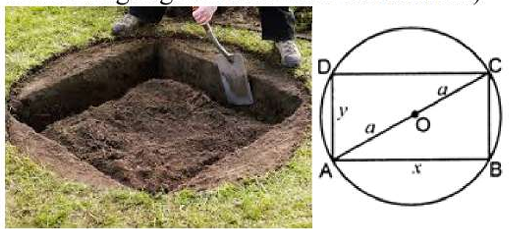
A gardener wants to construct a rectangular bed of garden in a circular patch of land. He takes the maximum perimeter of the rectangular region as possible. (Refer to the images given below for calculations) 

Image

(i) Find the perimeter of rectangle in terms of any one side and radius of circle.

(ii) Find critical points to maximize the perimeter of rectangle?

(iii) Check for maximum or minimum value of perimeter at critical point.

OR

If a rectangle of the maximum perimeter which can be inscribed in a circle of radius $10 \mathrm{~cm}$ is square, then the perimeter of region.

In a city there are two factories A and B. Each factory produces sports clothes for boys and girls. There are three types of clothes produced in both the factories, type I, II and III. For boys the number of units of types I, II and III respectively are 80, 70 and 65 in factory A and 85, 65 and 72 are in factory B. For girls the number of units of types I, II and III respectively are 80, 75, 90 in factory A and 50, 55, 80 are in factory B.

Based on the above information, answer the following questions:
  1. If P represents the matrix of number of units of each type produced by factory A for both boys and girls, then P is given by:
  1. $\begin{matrix}&\text{Boys}&\text{Girls}\end{matrix}\\\begin{matrix}\text{I}\\\text{II}\\\text{III}\end{matrix}\begin{bmatrix}85&50\\65&55\\72&80\end{bmatrix}$
  2. $\begin{matrix}&&&\text{I}\ \ \ &\text{II}&\text{III}\end{matrix}\\\begin{matrix}\text{Boys}\\\text{Girls}\end{matrix}\begin{bmatrix}50&55&80\\85&65&72\end{bmatrix}$
  3. $\begin{matrix}&&&\text{I}\ \ \ &\text{II}&\text{III}\end{matrix}\\\begin{matrix}\text{Boys}\\\text{Girls}\end{matrix}\begin{bmatrix}80&75&90\\80&70&65\end{bmatrix}$
  4. $\begin{matrix}&\text{Boys}&\text{Girls}\end{matrix}\\\begin{matrix}\text{I}\\\text{II}\\\text{III}\end{matrix}\begin{bmatrix}80&80\\70&75\\65&90\end{bmatrix}$
  1. If Q represents the matrix of number of units of each type produced by factory B for both boys and girls, then Q is given by:
  1. $\begin{matrix}&\text{Boys}&\text{Girls}\end{matrix}\\\begin{matrix}\text{I}\\\text{II}\\\text{III}\end{matrix}\begin{bmatrix}85&50\\65&55\\72&80\end{bmatrix}$
  2. $\begin{matrix}&&&\text{I}\ \ \ &\text{II}&\text{III}\end{matrix}\\\begin{matrix}\text{Boys}\\\text{Girls}\end{matrix}\begin{bmatrix}80&75&90\\80&70&65\end{bmatrix}$
  3. $\begin{matrix}&&&\text{I}\ \ \ &\text{II}&\text{III}\end{matrix}\\\begin{matrix}\text{Boys}\\\text{Girls}\end{matrix}\begin{bmatrix}80&75&90\\80&70&65\end{bmatrix}$
  4. $\begin{matrix}&\text{Boys}&\text{Girls}\end{matrix}\\\begin{matrix}\text{I}\\\text{II}\\\text{III}\end{matrix}\begin{bmatrix}80&80\\70&75\\65&90\end{bmatrix}$
  1. The total production of sports clothes of each type for boys is given by the matrix.
  1. $\begin{matrix}\ \ \text{I}&\ \ \ \ \text{II}&\ \ \ \text{III}\end{matrix}\\\begin{matrix}[165&130&137]\end{matrix}\\$
  2. $\begin{matrix}\ \ \text{I}&\ \ \ \ \text{II}&\ \ \ \text{III}\end{matrix}\\\begin{matrix}[130&165&137]\end{matrix}\\$
  3. $\begin{matrix}\ \ \text{I}&\ \ \ \ \text{II}&\ \ \ \text{III}\end{matrix}\\\begin{matrix}[165&135&137]\end{matrix}\\$
  4. $\begin{matrix}\ \ \text{I}&\ \ \ \ \text{II}&\ \ \ \text{III}\end{matrix}\\\begin{matrix}[137&135&165]\end{matrix}\\$
  1. The total production of sports clothes of each type for girls is given by the matrix.
  1. $\begin{matrix}\ \ \text{I}&\ \ \ \ \text{II}&\ \ \ \text{III}\end{matrix}\\\begin{matrix}[130&130&170]\end{matrix}\\$
  2. $\begin{matrix}\ \ \text{I}&\ \ \ \ \text{II}&\ \ \ \text{III}\end{matrix}\\\begin{matrix}[170&130&130]\end{matrix}\\$
  3. $\begin{matrix}\ \ \text{I}&\ \ \ \ \text{II}&\ \ \ \text{III}\end{matrix}\\\begin{matrix}[130&170&130]\end{matrix}\\$
  4. None of these
  1. Let R be a 3 × 2 matrix that represent the total production of sports dothes of each type for boys and girls, then transpose of R is:
  1. $\begin{bmatrix}165 & 135 & 137\\130 & 130 & 170 \end{bmatrix}$
  2. $\begin{bmatrix}130 & 130 & 170\\165 & 135 & 138 \end{bmatrix}$
  3. $\begin{bmatrix}165 & 132 \\135 & 130 \\137 & 170 \end{bmatrix}$
  4. $\begin{bmatrix}130 & 168 \\130 & 135 \\170 & 137 \end{bmatrix}$
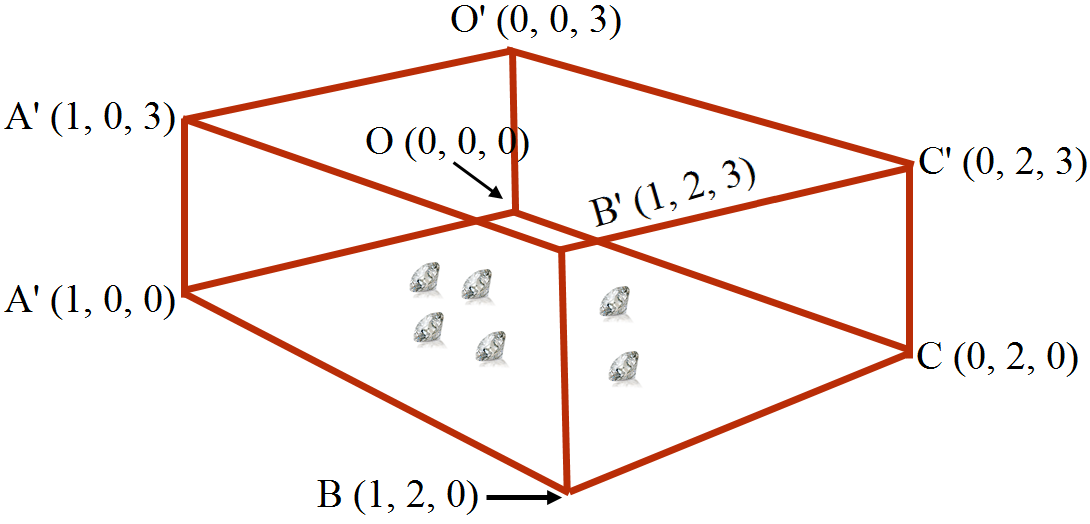
In a diamond exhibition, a diamond is covered in cubical glass box having coordinates O(0, 0, 0), A(1, 0, 0), B(1, 2, 0), C(0, 2, 0), O'(0, 0, 3), A'(1, 0, 3), B'(1, 2, 3) and C'(0, 2, 3).

Based on the above information, answer the following questions.
  1. Direction ratios of OA are:
  1. < 0, 1, 0 >
  2. < 1, 0, 0 >
  3. < 0, 0, 1 >
  4. None of these
  1. Equation of diagonal OB' is:
  1. $\frac{\text{x}}{1}=\frac{\text{y}}{2}=\frac{\text{z}}{3}$

  2. $\frac{\text{x}}{0}=\frac{\text{y}}{1}=\frac{\text{z}}{2}$

  3. $\frac{\text{x}}{1}=\frac{\text{y}}{0}=\frac{\text{z}}{2}$

  4. None of these
  1. Equation of plane OABC is:
  1. x = 0
  2. y = 0
  3. z = 0
  4. None of these
  1. Equation of plane O' A' B' C' is:
  1. x = 3
  2. y = 3
  3. z = 3
  4. z = 2
  1. Equation of plane ABB' A' is:
  1. x = 1
  2. y = 1
  3. z = 2
  4. x = 3
In a college hostel accommodating 1000 students, one of the hostellers came in carrying Corona virus, and the hostel was isolated. The rate at which the virus spreads is assumed to be proportional to the product of the number of infected students and remaining students. There are 50 infected students after 4 days.

Based on the above information, answer the following questions.

  1. If n(I) denote the number of students infected by Corona virus at any time I, then maximum value of n(I) is:
  1. 50
  2. 100
  3. 500
  4. 1000
  1. $\frac{\text{dn}}{\text{dt}}$ is proporuona to:
  1. n(1000 - n)
  2. n(100 + n)
  3. n(100 - n)
  4. n(100 + n)
  1. The value of n(4) is:
  1. 1
  2. 50
  3. 100
  4. 1000
  1. The most general solution of differential equation formed in given situation is:
  1. $\frac{1}{1000}\log\Big(\frac{1000-\text{n}}{\text{n}}\Big)=\lambda\text{t}+\text{c}$
  2. $\log\Big(\frac{\text{n}}{100-\text{n}}\Big)=\lambda\text{t}+\text{c}$
  3. $\frac{1}{1000}\log\Big(\frac{\text{n}}{1000-\text{n}}\Big)=\lambda\text{t}+\text{c}$
  4. None of these.
  1. The value of n at any time is given by:
  1. $\text{n(t)}=\frac{1000}{1+999\text{e}^{-0.9906\text{t}}}$
  2. $\text{n(t)}=\frac{1000}{1-999\text{e}^{-0.9906\text{t}}}$
  3. $\text{n(t)}=\frac{100}{1-999\text{e}^{-0.9906\text{t}}}$
  4. $\text{n(t)}=\frac{100}{1+999\text{e}^{-0.9906\text{t}}}$
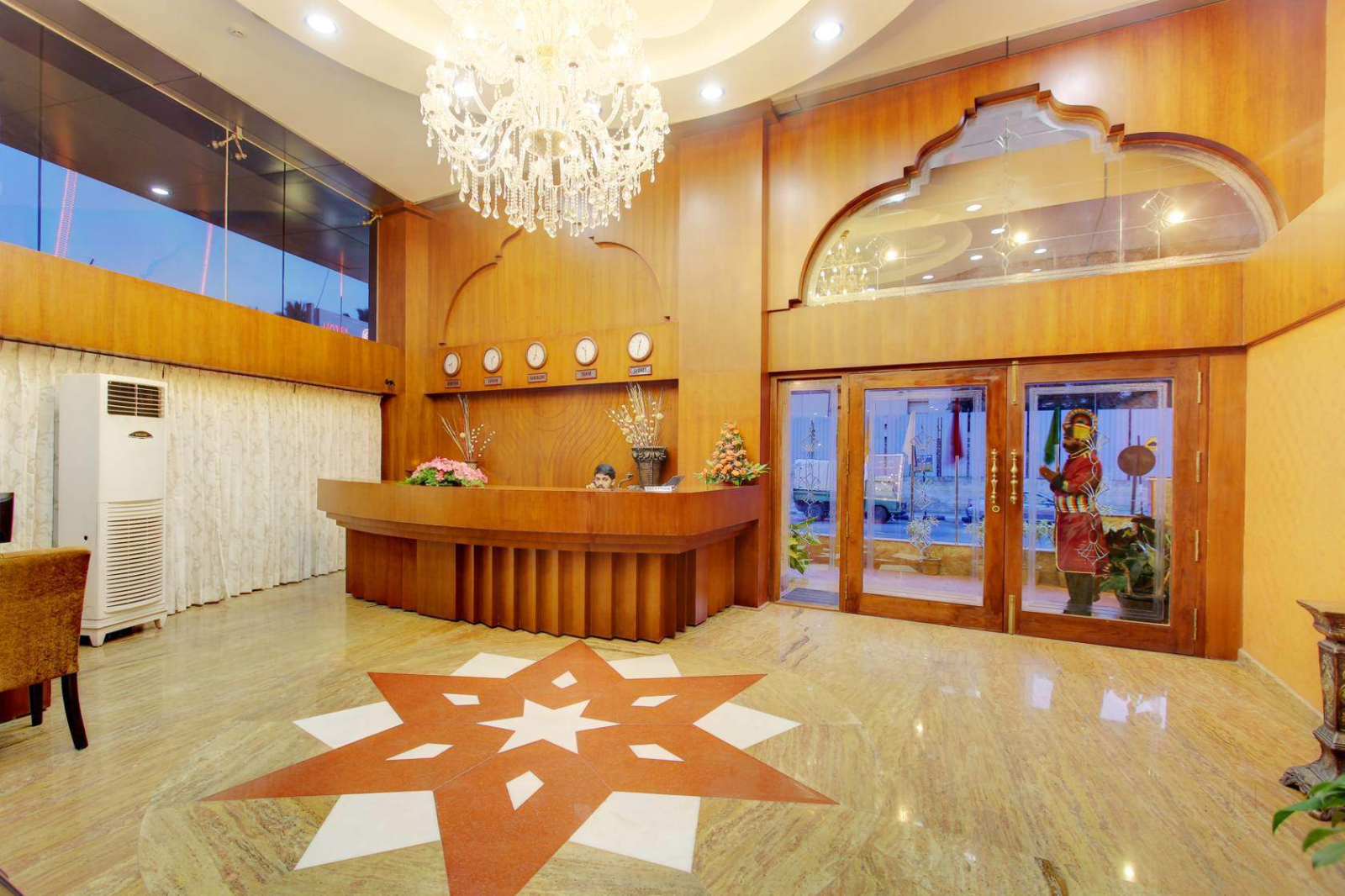
Suppose the floor of a hotel is made up of mirror polished Kota stone. Also, there is a large crystal chandelier attached at the ceiling of the hotel. Consider the floor of the hotel as a plane having equation x - 2y + 2z = 3 and crystal chandelier at the point (3, -2, 1).

Based on the above information, answer the following questions.

  1. The d.r'.s of the perpendicular from the point (3, -2, 1) to the plane x - 2y + 2z = 3, is:
  1. < 1, 2, 2 >
  2. < 1, -2, 2 >
  3. < 2, 1, 2 >
  4. < 2, -1, 2 >
  1. The length of the perpendicular from the point (3, -2, 1) to the plane x - 2y + 2z = 3, is:
  1. $\frac{2}{3}\text{units}$
  2. 3 units
  3. 2 units
  4. None of these
  1. The equation of the perpendicular from the point (3, -2, 1) to the plane x - 2y + 2z = 3, is:
  1. $\frac{\text{x}-3}{1}=\frac{\text{y}-2}{-2}=\frac{\text{z}-1}{2}$

  2. $\frac{\text{x}-3}{1}=\frac{\text{y}+2}{-2}=\frac{\text{z}-1}{2}$

  3. $\frac{\text{x}+3}{1}=\frac{\text{y}+2}{-2}=\frac{\text{z}-1}{2}$

  4. None of these
  1. The equation of plane parallel to the plane x - 2y + 2z = 3, which is at a unit distance from the point (3, -2, 1) is:
  1. x - 2y + 2z = 0
  2. x - 2y + 2z = 6
  3. x - 2y + 2z = 12
  4. Both (b) and (c)
  1. The image of the point (3, -2, 1) in the given plane is:
  1. $\Big(\frac{5}{3},\frac{2}{3},\frac{-5}{3}\Big)$

  2. $\Big(\frac{-5}{3},\frac{-2}{3},\frac{5}{3}\Big)$

  3. $\Big(\frac{-5}{3},\frac{2}{3},\frac{5}{3}\Big)$

  4. None of these
On a holiday, a father gave a puzzle from a newspaper to his son Ravi and his daughter Priya. The probability of solving this specific puzzle independently by Ravi and Priya are $\frac{1}{4}$ and $\frac{1}{5}$ respectively.


Based on the above information, answer the following questions.

  1. The chance that both Ravi and Priya solved the puzzle, is:
  1. 10%
  2. 5%
  3. 20%
  4. 25%
  1. Probability that puzzle is solved by Ravi but not by Priya, is:
  1. $\frac{1}{2}$

  2. $\frac{1}{5}$

  3. $\frac{3}{5}$

  4. $\frac{1}{3}$

  1. Find the probability that puzzle is solved.
  1. $\frac{1}{2}$

  2. $\frac{1}{5}$

  3. $\frac{2}{5}$

  4. $\frac{5}{6}$

  1. Probability that exactly one of them solved the puzzle, is:
  1. $\frac{1}{30}$

  2. $\frac{1}{20}$

  3. $\frac{7}{20}$

  4. $\frac{3}{20}$

  1. Probability that none of them solved the puzzle, is:
  1. $\frac{1}{5}$

  2. $\frac{3}{5}$

  3. $\frac{2}{5}$

  4. None of these