If $\theta$ is an acute angle such that $\tan^2\theta=\frac{8}{7},$ then the value of $\frac{(1+\sin\theta)(1-\sin\theta)}{(1+\cos\theta)(1-\cos\theta)}$ is:


Download our appand get started for free
Experience the future of education. Simply download our apps or reach out to us for more information. Let's shape the future of learning together!No signup needed.*
Similar Questions
- 1If $5\theta$ and $4\theta$ are acute angles satisfying $\sin5\theta=\cos4\theta,$ then $2\sin3\theta-\sqrt{3}\tan3\theta$ is equal to:View Solution
- 2If $\theta$ and $2\theta-45^\circ$ are acute angles such that $\sin\theta=\cos(2\theta-45^\circ),$ then $\tan\theta$ is equal to:View Solution
- 3The value of $\cos1^\circ\cos2^\circ\cos3^\circ.....\cos180^\circ$ is:View Solution
- 4If $A$ and $B$ are complementary angles, then:View Solution
- 5If $5\tan\theta-4=0,$ then the value of $\frac{5\sin\theta-4\cos\theta}{5\sin\theta+4\cos\theta}$ is:View Solution
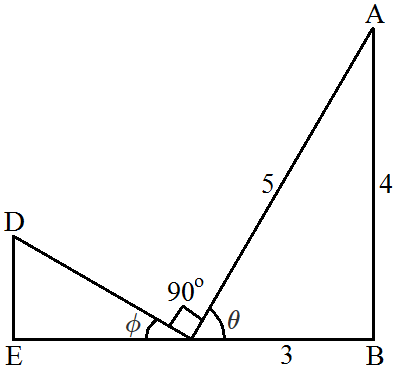
- 6In Fin. the value of $\cos\phi$ is:View Solution
- 7The value of $\cos^217^\circ-\sin^273^\circ$ is:View Solution
- 8If $\tan^245^\circ-\cos^230^\circ=\text{x}\sin45^\circ\cos45^\circ,$ then x =View Solution
- 9$\sin2\text{A}=2\sin\text{A}$ is true when A =View Solution
- 10If A + B = 90°, then $\frac{\tan\text{A}\tan\text{B}+\tan\text{A}\cot\text{B}}{\sin\text{A}\sec\text{B}}-\frac{\sin^2\text{B}}{\cos^2\text{A}}$ is equal to:View Solution