MCQ
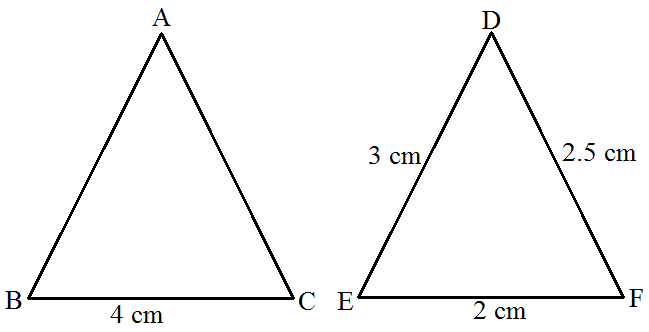
If $\triangle\text{ABC}\sim\triangle\text{DEF}$ such that $DE = 3\ cm, EF = 2\ cm, DF = 2.5\ cm, BC = 4\ cm,$ then perimeter of $\triangle\text{ABC}$ is:
  • A
    $18\ cm.$
  • B
    $20\ cm.$
  • C
    $12\ cm.$
  • $15\ cm.$

Answer

Correct option: D.
$15\ cm.$

$\triangle\text{ABC}\sim\triangle\text{DEF}$
$DE = 3\ cm, EF = 2\ cm, DF = 2.5\ cm, BC = 4\ cm$
$\because\triangle\text{ABC}\sim\triangle\text{DEF}$
$\therefore$ Perimeter of $\triangle\text{DEF}$
$= DE + EF + DF$
$= 3 + 2 + 2.5$
$= 7.5\ cm$
Now $\frac{\text{AB}}{\text{DE}}=\frac{\text{BC}}{\text{EF}}=\frac{\text{AC}}{\text{DF}}=\frac{\text{AB}+\text{BC}+\text{CA}}{\text{DE}+\text{EF}+\text{DF}}$
$=\frac{4}{2}=\frac{\text{AB}+\text{BC}+\text{CA}}{7.5}$
$\Rightarrow\text{AB}+\text{BC}+\text{CA}=\frac{4\times7.5}{2}=15$
$\therefore$ Perimeter of $\triangle\text{ABC}=15\text{cm}.$

Need a full question paper?

Generate a complete, print-ready paper with questions like this in minutes — across 16+ boards, with answer keys.

Start Generating Free

Similar questions

The curved surface are of a cylinder is $1760\ cm^2$ and its base radius is $14\ cm$. The height of the cylinder is:
Sum of first five multiples of 3 is. . .
If $\frac{2\text{x}}{3}-\frac{\text{y}}{2}+\frac{1}{6}=0$ and $\frac{\text{x}}{2}+\frac{2\text{y}}{3}=3$ then:
If $\cos\text{A}+\cos^2\text{A}=1$ then $\sin^2\text{A}+\sin^4\text{A}=?$
If $a = 2^3 \times 3, b = 2 \times 3 \times 5, c = 3^n \times 5$ and $\text{LCM} (a, b, c) = 2^3 \times 3^2 \times 5$, then $n =$
Assertion and Reason Type
Each question consists of two statements, namely, Assertion $(A)$ and Reason $(R)$. For selecting the correct answer, use the following code:
Assertion $(A)$
Reason $(R)$
If the radii of the circular ends of a bucket $24\ cm$ high are $15\ cm$ and $5\ cm$ respectively, then the surface area of the bucket is $545\pi\text{cm}^2.$
if the radii of the circular ends of the frustum of a cone are $R$ and $r$ respectively and its height is $h,$ surface area is:
$\pi\big\{\text{R}^2+\text{r}^2+\text{l}(\text{R}-\text{r})\big\}$
where $\text{l}^2=\text{h}^2+(\text{R}+\text{r})^2.$
$\cos^230^\circ\cot^245^\circ+4\sec^260^\circ+\frac{1}{2}\cos^290^\circ-2\tan^260^\circ=?$
A circus tent is cylindrical to a height of $4\ m$ and conical above it. If its diameter is $105\ m$ and its slant height is $40\ m$, the total area of the canvas required in $m^2$ is:
The diameter of the base of a cone is $42\ cm$ and its volume is $12936\ cm^3$. Its height is:
$\triangle ABC \sim \triangle AQR . \quad \frac{A B}{A Q}=\frac{7}{5}$ then which of the following option is true.