- ✓zero
- B$\frac{\sigma}{\varepsilon_0}$
- C$\frac{\sigma}{2 \varepsilon_0}$
- D$\frac{2 \sigma}{\varepsilon_0}$
Generate a complete, print-ready paper with questions like this in minutes — across 16+ boards, with answer keys.
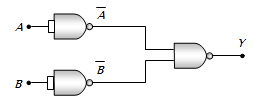
The combination of the gates shown in the figure below produces

|
(a) NOR gate |
(b) OR gate |
(c) AND gate |
(d) XOR gate |
In X-ray tube when the accelerating voltage V is halved, the difference between the wavelength of Ka line and minimum wavelength of continuous X-ray spectrum
|
(a) Remains constant |
(b) Becomes more than two times |
|
(c) Becomes half |
(d) Becomes less than two times |
Two electric dipoles of moment P and 64 P are placed in opposite direction on a line at a distance of 25 cm. The electric field will be zero at point between the dipoles whose distance from the dipole of moment P is
|
(a) 5 cm |
(b) |
(c) 10 cm |
(d) |
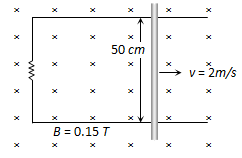
As shown in the figure a metal rod makes contact and complete the circuit. The circuit is perpendicular to the magnetic field with B = 0.15 tesla. If the resistance is 3Ω, force needed to move the rod as indicated with a constant speed of 2m/sec is

|
(a) 3.75 |
(b) 3.75 |
(c) 3.75 |
(d) 3.75 |
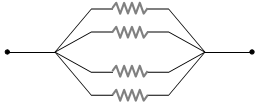
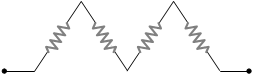
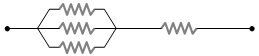
Which arrangement of four identical resistances should be used to draw maximum energy from a cell of voltage V
|
(a)
|
(b)
|
|
(c)
|
(d)
|
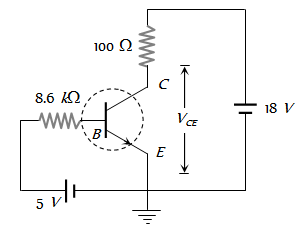
For the transistor circuit shown below, if b = 100, voltage drop between emitter and base is 0.7 V then value of VCE will be

|
(a) 10 V |
(b) 5 V |
(c) 13 V |
(d) 0 V |
An electron enters a region where electrostatic field is 20N/C and magnetic field is 5T. If electron passes undeflected through the region, then velocity of electron will be
|
(a) |
(b) |
(c) |
(d) |
A 2 MeV proton is moving perpendicular to a uniform magnetic field of 2.5 tesla. The force on the proton is
|
(a) 2.5 |
(b) 7.6 |
(c) 2.5 |
(d) 7.6 |
Assertion : In everyday life the Doppler’s effect is observed readily for sound waves than light waves.
Reason : Velocity of light is greater than that of sound.
|
(a) If both assertion and reason are true and the reason is the correct explanation of the assertion. |
|
(b) If both assertion and reason are true but reason is not the correct explanation of the assertion. |
|
(c) If assertion is true but reason is false. |
|
(d) If the assertion and reason both are false. |