Question
If two lines intersect, prove that the vertically opposite angles are equal.
Answer

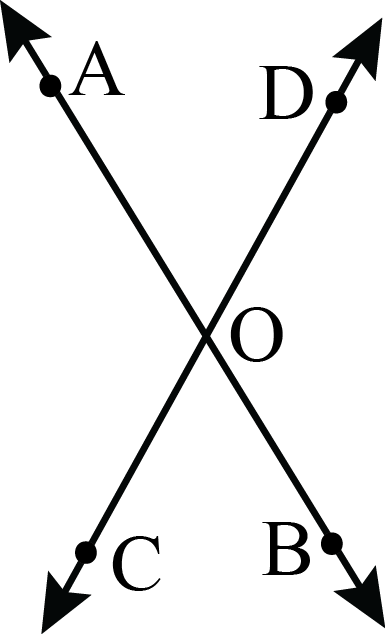
Given, two lines $AB$ and $CD$ intersect at point $O$.
To prove
$(i)\ce{ \angle AOC =\angle BOD}$
$(ii)\ce{ \angle AOD=\angle BOC}$
Proof:
$(i)$ Ray $OA$ stands on line $CD.$
$\therefore\ce{ \angle AOC + \angle AOD}=180^{\circ} [$linear pair axiom$] ...(i)$ Ray $OD$ stands on line $AB$.
$\therefore \ce{\angle AOD + \angle BOD}=180^{\circ} [$linear pair exiom $] \ldots (ii)$
Image
From the equations $(i)$ and $(ii),$
$\Rightarrow \angle \ce{AOC + \angle AOD=\angle AOD + \angle BOD}$
$\ce{\angle AOC=\angle BOD}$
$(ii)$ Ray $OD$ stands on line $AB$.
$ \therefore \ce{\angle AOD + \angle BOD}=180^{\circ}[$ linear pair axiom $] \ldots (iii)$
Ray $OB$ stands on line $CD.$
$ \therefore \ce{\angle DOB + \angle BOC=180^{\circ}}$
From equations $(iii)$ and $(iv)$
$\Rightarrow \ce{\angle AOD + \angle BOD=\angle DOB+\angle BOC}$
$\ce{\angle AOD=\angle BOC}$
Hence proved.

Need a full question paper?

Generate a complete, print-ready paper with questions like this in minutes — across 16+ boards, with answer keys.
Start Generating Free

Similar questions

$A B C D$ is a quadrilateral in which $P, Q, R$ and $S$ are mid-points of the sides $A B, B C, C D$ and $D A . A C$ is a diagonal. Show that
i. $S R \| A C$ and $S R=\frac{1}{2} A C$
ii. $P Q=S R$
iii. $PQRS$ is a parallelogram.
In the adjoining figure, $\text{ABCD}$ is a quadrilateral and $AC$ is one of its diagonals. Prove that:
$(i) AB + BC + CD + DA > 2AC $
$(ii) AB + BC + CD > DA$
$(iii) AB + BC + CD + DA > AC + BD$
If two intersecting chords of a circle make equal angles with the diameter passing through their point of intersection, prove that the chords are equal.
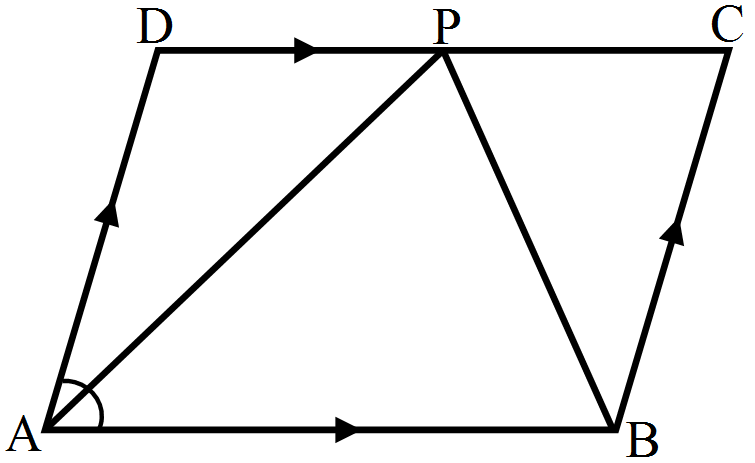
In the adjoining figure, $\text{ABCD}$ is a parallelogram in which $\angle\text{A}=60^{\circ}.$ If the bisectors of $\angle\text{A}$ and $\angle\text{B}$ meet $DC$ at $P$, prove that
$i. \angle\text{APB}=90^{\circ},$
$ii. AD = DP$ and $PB = PC = BC$,
$iii. DC = 2AD$.
Two circles with centres $O$ and $O'$ intersect at two points $A$ and $B$. $A$ line $PQ$ is drawn parallel to $OO'$ through $A$ or $B$, intersecting the circles at $P$ and $Q$. Prove that $PQ = 2OO'$.
Find the area of a trapezium whose parallel sides are $11\ m$ and $25\ m$ long, and the nonparallel sides are $15\ m$ and $13\ m$ long.
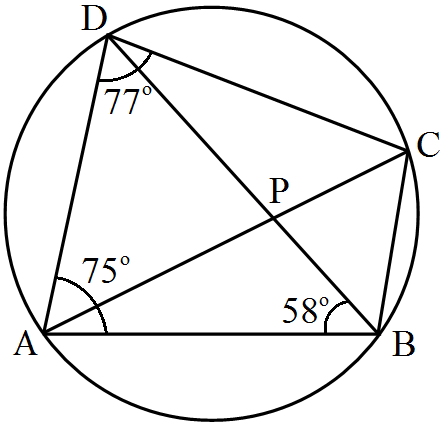
In the given figure, $ABCD$ is a cyclic quadrilateral in which $\angle\text{BAD} = 75^\circ,\ \angle\text{ABD} = 58^\circ$ and $\angle\text{ADC} = 77^\circ, AC$ and $BD$ intersect at $P.$ Then, find $\angle\text{DPC}.$
The polynomial $p(x)=x^4-2 x^3+3 x^2-a x+3 a-7$ when divided by $x+1$ leave remainder $19 .$ Find the remainder when $p(x)$ is divided by $x +2$.
The ages (in years) of $360$ patients treated in a hospital on a particular day are given below:
Age in years
$10-20$
$20-30$
$30-40$
$40-50$
$50-60$
$60-70$
Number of patients
$90$
$40$
$60$
$20$
$120$
$30$
Draw a histogram and a frequency polygon on the same graph to represent the above data.
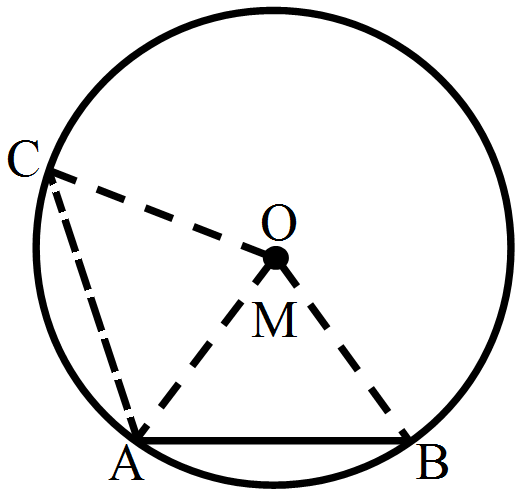
In the adjoining figure, $AB$ and $AC$ are two equal chords of a circle with centre $O$. Show that $O$ lies on the bisector of $\angle\text{BAC}.$