MCQ
If two metallic plates of equal thicknesses and thermal conductivities ${K_1}$ and ${K_2}$ are put together face to face and a common plate is constructed, then the equivalent thermal conductivity of this plate will be

  • A
    $\frac{{{K_1}{K_2}}}{{{K_1} + {K_2}}}$
  • $\frac{{2{K_1}{K_2}}}{{{K_1} + {K_2}}}$
  • C
    $\frac{ K _{1}+ K _{2}}{2 K _{1} K _{2}}$
  • D
    $\frac{ K _{1}+ K _{2}}{ K _{1} K _{2}}$
Answer

Correct option: B.
$\frac{{2{K_1}{K_2}}}{{{K_1} + {K_2}}}$
b
(b) In series ${R_{eq}} = {R_1} + {R_2}$

==> $\frac{{2l}}{{{K_{eq}}A}} = \frac{l}{{{K_1}A}} + \frac{l}{{{K_2}A}}$

==> $\frac{2}{{{K_{eq}}}} = \frac{1}{{{K_1}}} + \frac{1}{{{K_2}}}$

==> ${K_{eq}} = \frac{{2{K_1}{K_2}}}{{{K_1} + {K_2}}}$

Need a full question paper?

Generate a complete, print-ready paper with questions like this in minutes — across 16+ boards, with answer keys.

Start Generating Free

Similar questions

The dimensions $\left[ MLT ^{-2} A ^{-2}\right]$ belong to the :
A force vector applied on a mass is represented as $\vec F = 6\hat i - 8\hat j + 10\hat k$ and accelerates with $1\,m/{s^2}$. What will be the mass of the body
How many waves of Kr86 are there in one meter?
A car of mass $m$ is driven with an acceleration a along a straight level road against a constant externally resistive force $R$. When the velocity of the car is $V$, the rate at which the engine of the car is doing work is:
A body of mass $200\,g$ is tied to a spring of spring constant $12.5\,N / m$, while the other end of spring is fixed at point $O$. If the body moves about $O$ in a circular path on a smooth horizontal surface with constant angular speed $5\,rad / s$, then the ratio of extension in the spring to its natural length will be :
An engine is attached to a wagon through a shock absorber of length $1.5\, {m}$. The system with a total mass of $40,000\, {kg}$ is moving with a speed of $72\, {kmh}^{-1}$ when the brakes are applied to bring it to rest. In the process of the system being brought to rest, the spring of the shock absorber gets compressed by $1.0\, {m}$. If $90\, \%$ of energy of the wagon is lost due to friction, the spring constant is $....\, \times 10^{5}\, {N} / {m}$
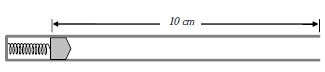
A toy gun fires a plastic pellet with a mass of $0.5\  g$. The pellet is propelled by a spring with a spring constant of $1.25\  N/cm$, which is compressed $2.0\  cm$ before firing. The plastic pellet travels horizontally $10\  cm$ down the barrel (from its compressed position) with a constant friction force of $0.0475\  N$. What is the speed (in $SI\  units$) of the bullet as it emerges from the barrel?
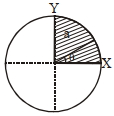
The disc of mass $M$ with uniform surface mass density $\sigma$ is shown in the figure. The centre of mass of the quarter disc (the shaded area) is at the position $\frac{x}{3} \frac{a}{\pi}, \frac{x}{3} \frac{a}{\pi}$ where $x$ is ....... .

(Round off to the Nearest Integer) $[ a$ is an area as shown in the figure $]$

The picture of a progressive transverse wave at a particular instant of time gives:
A particle moves with simple harmonic motion in a straight line. In first $\tau \,s,$ after starting from rest it travels a distance $a,$ and in next $\tau \,s$ it travels $2a,$ in same direction, then