MCQ
If two streams of protons move parallel to each other in the same direction, then they
  • A
    Do not exert any force on each other
  • Repel each other
  • C
    Attract each other
  • D
    Get rotated to be perpendicular to each other

Answer

Correct option: B.
Repel each other
b
(b) For charge particles, if they are moving freely in space, electrostatic force is dominant over magnetic force between them. Hence due to electric force they repel each other.

Need a full question paper?

Generate a complete, print-ready paper with questions like this in minutes — across 16+ boards, with answer keys.
Start Generating Free

Similar questions

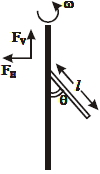
A uniform rod of length $'l'$ is pivoted at one of its ends on a vertical shaft of negligible radius When the shaft rotates at angular speed $\omega$ the rod makes an angle $\theta$ with it (see figure). To find $\theta$ equate the rate of change of angular momentum (direction going into the paper ) $\frac{ m \ell^{2}}{12} \omega^{2} \sin \theta \cos \theta$ about the centre of mass $(CM)$ to the torque provided by the horizontal and vertical forces $F_{H}$ and $F_{V}$ about the CM. The value of $\theta$ is then such that:
Two convex lenses of focal lengths $0.3 \,m$ and $0.05 \,m$ are used to make a telescope. The distance kept between the two is....$m$
An electron having de-Broglie wavelength $\lambda$ is incident on a target in a X-ray tube. Cut-off wavelength of emitted $X$-ray is :
The work function of metal is $1\; eV$. Light of wavelength $3000 \,\mathring A$ is incident on this metal surface. The velocity of emitted photo-electrons will be
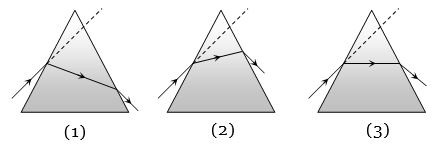
The figures represent three cases of a ray passing through a prism of angle $A.$ The case corresponding to minimum deviation is
The nucleus $_{92}{U^{234}}$ splits exactly in half in a fission reaction in which two neutrons are released. The resultant nuclei are
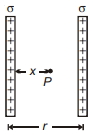
For two infinitely long charged parallel sheets, the electric field at $P$ will be
Ratio of amplitude of interfering waves is $3 : 4$. Now ratio of their intensities will be
In an experiment, brass and steel wires of length $1\,m$ each with areas of cross section $1\,mm^2$ are used. The wires are connected in series and one end of the combined wire is connected to a rigid support and other end is subjected to elongation. The stress requires to produced a new elongation of $0.2\,mm$ is [Given, the Young’s Modulus for steel and brass are respectively $120\times 10^9\,N/m^2$ and $60\times 10^9\,N/m^2$ ]
The composition of an $\alpha $- particle can be expressed as