MCQ
If $u = \sqrt {{a^2}{{\cos }^2}\theta + {b^2}{{\sin }^2}\theta } + \sqrt {{a^2}{{\sin }^2}\theta + {b^2}{{\cos }^2}\theta } $, then difference between the maximum and minimum values of ${u^2}$ is given by
  • ${(a - b)^2}$
  • B
    $2\sqrt {{a^2} + {b^2}} $
  • C
    ${(a + b)^2}$
  • D
    $2({a^2} + {b^2})$

Answer

Correct option: A.
${(a - b)^2}$
a
(a) $2u = \sqrt {{a^2}{{\cos }^2}\theta + {b^2}{{\sin }^2}\theta } + \sqrt {{a^2}{{\sin }^2}\theta + {b^2}{{\cos }^2}\theta } $
${u^2} = {a^2} + {b^2} + 2\sqrt {({a^2}{{\cos }^2}\theta + {b^2}{{\sin }^2}\theta )({a^2}{{\sin }^2}\theta + {b^2}{{\cos }^2}\theta )} $
$ = {a^2} + {b^2} + 2\sqrt {t({a^2} + {b^2} - t)} $
$ = {a^2} + {b^2} + 2\sqrt { - {t^2} + ({a^2} + {b^2})t} $
where $t = {a^2}{\cos ^2}\theta + {b^2}{\sin ^2}\theta ,\,({a^2} > {b^2})$
${t_{\max }} = {a^2}$ and ${t_{\min }} = {b^2}.$
Let $y = - {t^2} + ({a^2} + {b^2})t$
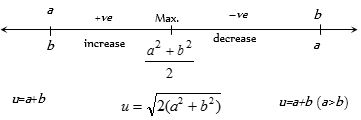
Now $\frac{{dy}}{{dt}} = 0 \Rightarrow - 2t + ({a^2} + {b^2}) = 0 \Rightarrow t = \frac{{{a^2} + {b^2}}}{2}$
Sign scheme for $\frac{{dy}}{{dt}}$
$\therefore$ ${({u_{\max }})^2} - {({u_{\min }})^2} = 2({a^2} + {b^2}) - {(a + b)^2} = {(a - b)^2}$

Need a full question paper?

Generate a complete, print-ready paper with questions like this in minutes — across 16+ boards, with answer keys.

Start Generating Free

Similar questions

Let $\alpha =\sum_{n=101}^{200} 2^n \sum_{k=101}^n \frac{1}{k !}$ and $b=\sum_{n=101}^{200} \frac{2^{201}-2^n}{n !}$ Then, $\frac{a}{b}$ is
If the sum of the first ten terms of the series ${\left( {1\frac{3}{5}} \right)^2} + {\left( {2\frac{2}{5}} \right)^2} + {\left( {3\frac{1}{5}} \right)^2} + {4^2} + \;\;.\;.\;.\;.\;,$ is $\frac{{16}}{5}m$ then $m$ is equal to :
Let $P : y ^{2}=4 a x , a>0$ be a parabola with focus $S$.Let the tangents to the parabola $P$ make an angle of $\frac{\pi}{4}$ with the line $y=3 x+5$ touch the parabola $P$ at $A$ and $B$. Then the value of $a$ for which $A , B$ and $S$ are collinear is
The sum of all two digit positive numbers which when divided by $7$ yield $2$ or $5$ as remainder is
$ABC$ is a triangle in which angle $C$ is a right angle. If the coordinates of $A$ and $B$ be $(-3, 4)$ and $(3, -4)$ respectively, then the equation of the circumcircle of triangle $ABC$ is
The equation of a straight line drawn through the focus of the parabola ${y^2} = - 4x$ at an angle of $120^o $ to the $x$ - axis is
The inverse function of $f(\mathrm{x})=\frac{8^{2 \mathrm{x}}-8^{-2 \mathrm{x}}}{8^{2 \mathrm{x}}+8^{-2 \mathrm{x}}}, \mathrm{x} \in(-1,1),$ is
Let $\vec{a}=-\hat{i}-\hat{k}, \vec{b}=-\hat{i}+\hat{j}$ and $\vec{c}=\hat{i}+2 \hat{j}+3 \hat{k}$ be three given vectors. If $\vec{r}$ is a vector such that $\vec{r} \times \vec{b}=\vec{c} \times \vec{b}$ and $\vec{r} \cdot \vec{a}=0$, then the value of $\vec{r} \cdot \vec{b}$ is
If $\int {\frac{{{a^x}{e^{2x}}}}{{{b^x}{c^x}}}dx = \frac{1}{k}\left( {\frac{{{a^x}{e^{2x}}}}{{{b^x}{c^x}}}} \right)}  + l$ then $k =$
Three urns $A$, $B$ and $C$ contain $7$ red, $5$ black; $5$ red, $7$ black and $6$ red, $6$ black balls, respectively. One of the urn is selected at random and a ball is drawn from it. If the ball drawn is black, then the probability that it is drawn from urn $\mathrm{A}$ is :