MCQ
If $u = \sqrt {{a^2}{{\cos }^2}\theta + {b^2}{{\sin }^2}\theta } + \sqrt {{a^2}{{\sin }^2}\theta + {b^2}{{\cos }^2}\theta } $, then difference between the maximum and minimum values of ${u^2}$ is given by
  • ${(a - b)^2}$
  • B
    $2\sqrt {{a^2} + {b^2}} $
  • C
    ${(a + b)^2}$
  • D
    $2({a^2} + {b^2})$

Answer

Correct option: A.
${(a - b)^2}$
a
(a) $2u = \sqrt {{a^2}{{\cos }^2}\theta + {b^2}{{\sin }^2}\theta } + \sqrt {{a^2}{{\sin }^2}\theta + {b^2}{{\cos }^2}\theta } $
${u^2} = {a^2} + {b^2} + 2\sqrt {({a^2}{{\cos }^2}\theta + {b^2}{{\sin }^2}\theta )({a^2}{{\sin }^2}\theta + {b^2}{{\cos }^2}\theta )} $
$ = {a^2} + {b^2} + 2\sqrt {t({a^2} + {b^2} - t)} $
$ = {a^2} + {b^2} + 2\sqrt { - {t^2} + ({a^2} + {b^2})t} $
where $t = {a^2}{\cos ^2}\theta + {b^2}{\sin ^2}\theta ,\,({a^2} > {b^2})$
${t_{\max }} = {a^2}$ and ${t_{\min }} = {b^2}.$
Let $y = - {t^2} + ({a^2} + {b^2})t$
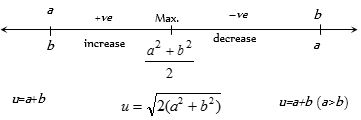
Now $\frac{{dy}}{{dt}} = 0 \Rightarrow - 2t + ({a^2} + {b^2}) = 0 \Rightarrow t = \frac{{{a^2} + {b^2}}}{2}$
Sign scheme for $\frac{{dy}}{{dt}}$
$\therefore$ ${({u_{\max }})^2} - {({u_{\min }})^2} = 2({a^2} + {b^2}) - {(a + b)^2} = {(a - b)^2}$

Need a full question paper?

Generate a complete, print-ready paper with questions like this in minutes — across 16+ boards, with answer keys.

Start Generating Free

Similar questions

Let $S$ be the set of all solutions of the equation $\cos ^{-1}(2 x)-2 \cos ^{-1}\left(\sqrt{1-x^2}\right)=\pi, \quad x \in\left[-\frac{1}{2}, \frac{1}{2}\right]$.Then $\sum_{x \in S} 2 \sin ^{-1}\left(x^2-1\right)$ is equal to
If $w$ is a non $-$ real cube root of unity and $n$ is not a multiple of $3,$ then $\begin{vmatrix}1&\omega^{\text{n}}&\omega^{2\text{n}}\\\omega^{2\text{n}}&1&\omega^{\text{n}}\\\omega^{\text{n}}&\omega^{2\text{n}}&1\end{vmatrix}$ is equal to :
Characteristic equation of $A = \left| {\begin{array}{*{20}{c}}
2&3&0\\
1&2&5\\
3&{ - 1}&2
\end{array}} \right|$ is 
The area of the region $\{(\text{x},\text{y}):\text{y}^2\leq4\text{x},4\text{x}^2+4\text{y}^2\leq9\}$ is:
A relation R is defined in set N of natural numbers such as $m R n \Leftrightarrow m$ is divisible of $n . \forall m, n \in N$, Then $R$ is :
If $\vec{a}$ and $\vec{b}$ are two collinear vectors, then which of the following are incorrect:
The value of $\sin\Big(\frac{1}{4}\sin^{-1}\frac{\sqrt{63}}{8}\Big)$ is:
Given $P\left( x \right) = {x^4} + a{x^3} + b{x^2} + cx + d$ such that $x=0 $ is the only real root of  $P'\left( x \right) = 0$ . If  $P(-1) < P(1)$ ,then in the interval $[-1,1]$
The value of $b$ for which the function $\text{f(x)}=\begin{cases}5\text{x}-4,&0<\text{x}\leq1\\4\text{x}^2+3\text{bx},&1<\text{x}<2\end{cases}$ is continuous at every point of its domain, is :
What are the order and degree, respectively, of the differential equation : $\Big(\frac{\text{d}^3\text{y}}{\text{dx}^3}\Big)^2=\text{y}^4+\Big(\frac{\text{dy}}{\text{dx}}\Big)^5\ ?$