MCQ
If $v$ is the speed of sound in air then the shortest length of the closed pipe which resonates to a frequency $n$
  • $\frac{v}{{4n}}$
  • B
    $\frac{v}{{2n}}$
  • C
    $\frac{{2n}}{v}$
  • D
    $\frac{{4n}}{v}$

Answer

Correct option: A.
$\frac{v}{{4n}}$
a
(a) For shortest length of pipe mode of vibration must be fundamental

i.e., $n = \frac{v}{{4l}}$==> $l = \frac{v}{{4n}}.$

Need a full question paper?

Generate a complete, print-ready paper with questions like this in minutes — across 16+ boards, with answer keys.

Start Generating Free

Similar questions

The motion of a particle represented by $y\ =$ $\sin \omega t - \cos \omega t$ is
If g is the acceleration due to gravity at the earth's surface and $r$ is the radius of the earth, the escape velocity for the body to escape out of earth's gravitational field is
Let $\mathrm{i}_{\mathrm{E}}$, $\mathrm{i}_{\mathrm{C}}$ and $\mathrm{i}_{\mathrm{B}}$ represent the emitter current, the collector current and the base current respectively in a transistor. Then,
Which one of the following relations is true?
Newton's law of cooling is used in laboratory for the determination of the
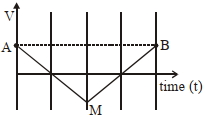
If the velocity-time graph has the shape $AMB$, what would be the shape of the corresponding acceleration-time graph ?
A wire is stretched between two rigid supports vibrates in its fundamental mode with a frequency of $50\,\, Hz$ . The mass of the wire is $30\,\, g$ and its linear density is $4\, \times \, 10^{-2}\,\, kg/m$ . The speed of the transverse wave at the string is  ...... $ms^{-1}$
Two bodies moving towards each other collide and move away in opposite directions. There is some rise in temperature of bodies because a part of the kinetic energy is converted into
Two persons of masses $55\, kg$ and $65\, kg$ respectively, are at the opposite ends of a boat. The length of the boat is $3.0\, m$ and weighs $100\, kg.$ The $55\, kg$ man walks up to the $65\, kg$ man and sits with him. If the boat is in still water the center of mass of the system shifts by ....... $m$
Two masses of $10 \,kg$ and $20 \,kg$ respectivety are connected by a massless spring as shown in fig. A force of $200 \,N$ acts on the $20 \,kg$ mass At the instant shown the $10 \,kg$ mass has acceleration $12 \,m / s ^2$ towards right. The acceleration of $20 \,kg$ mass at this instant is ........ $m / s ^2$