MCQ
If $\vec a = 2\hat i + \hat j + \hat k,\vec b = \hat i + 2\vec j + 2\vec k,\vec c = \vec i + \vec j + 2\hat k$ and $\left( {1 + \alpha } \right)\hat i + \beta \left( {1 + \alpha } \right)\hat j + \gamma \left( {1 + \alpha } \right)\left( {1 + \beta } \right)\hat k = \hat a \times \left( {\vec b \times \vec c} \right)$ ,  then $\alpha ,\beta ,\gamma $ are
  • $ - 2, - 4, - \frac{2}{3}$
  • B
    $  2, - 4,  \frac{2}{3}$
  • C
    $ - 2,  4,  \frac{2}{3}$
  • D
    $  2,  4, - \frac{2}{3}$

Answer

Correct option: A.
$ - 2, - 4, - \frac{2}{3}$
a
$\vec{a} \times(\vec{b} \times \vec{c})=(\vec{a} \cdot \vec{c}) \vec{b}-(\vec{a} \cdot \vec{b}) \vec{c}$

$\Rightarrow \alpha=-2 ; \beta=-4: \gamma=-\frac{2}{3}$

Need a full question paper?

Generate a complete, print-ready paper with questions like this in minutes — across 16+ boards, with answer keys.

Start Generating Free

Similar questions

For determinant A, if $A=\left|\begin{array}{ccc}1 & 2 & 13 \\ 3 & 0 & 5 \\ 6 & 7 & 11\end{array}\right|$ and p, q and r are cofactors of 13, 5 and 11 respectively, then p + 3q + 6r = _________.
The area of region $\{ \,(x,\,y):{x^2} + {y^2} \le 1 \le x + y\} $ is
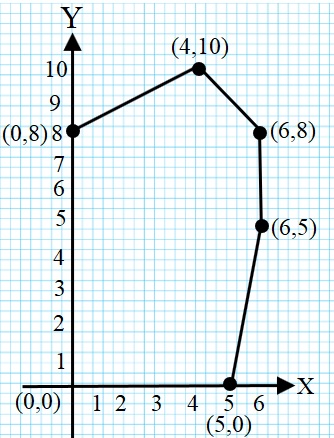
The feasible region for an LPP is shown below:

Let Z = 3x - 4y be the objective function. Minimum of Z occurs at

  1. (0, 0)
  2. (0, 8)
  3. (5, 0)
  4. (4, 10)
Let $\overrightarrow{\mathrm{a}}=2 \hat{\mathrm{i}}-3 \hat{\mathrm{j}}+4 \hat{\mathrm{k}}, \overrightarrow{\mathrm{b}}=3 \hat{\mathrm{i}}+4 \hat{\mathrm{j}}-5 \hat{\mathrm{k}}$, and a vector $\vec{c}$ be such that $\vec{a} \times(\vec{b}+\vec{c})+\vec{b} \times \vec{c}=\hat{i}+8 \hat{j}+13 \hat{k}$. If $\vec{a} \cdot \vec{c}=13$, then $(24-\vec{b} \cdot \vec{c})$ is equal to ...........
Two distinct numbers $a$ and $b$ are chosen randomly from the set {$2, 2^2, 2^3, ........ 22^5$}. What is the probability the $log(ab)$ is an integer ?
The length of the perpendicular drawn from the point $(4,-7,3)$ on the $y$-axis is
Choose the correct answer from the given four options.
The maximum number of equivalence relations on the set A = {1, 2, 3} are:
  1. 1
  2. 2
  3. 3
  4. 5
The vectors $\vec{\text{a}}$ and $\vec{\text{b}}$ satisfy the equation $2\vec{\text{a}}+\vec{\text{b}}=\vec{\text{p}}$ and $\vec{\text{a}}+2\vec{\text{b}}=\vec{\text{q}},$ where $\vec{\text{p}}=\hat{\text{i}}+\hat{\text{j}}$ and $\vec{\text{q}}=\hat{\text{i}}-\hat{\text{j}}.$ If $\theta$ is the angle between $\vec{\text{a}}$ and $\vec{\text{b}},$ then:
  1. $\cos \theta = \frac{4}{5}$
  2. $\sin \theta = \frac{1}{\sqrt{2}}$
  3. $\cos \theta = -\frac{4}{5}$
  4. $\cos \theta = -\frac{3}{5}$
If a line makes angles $\alpha,\beta,\gamma,\delta$ with four diagonals of a cube, then $\cos^2\alpha+\cos^2\beta+\cos^2\gamma+\cos^2\delta$ is equal to:
  1. $\frac{1}{3}$
  2. $\frac{2}{3}$
  3. $\frac{4}{3}$
  4. $\frac{8}{3}$
$\left| {\,\begin{array}{*{20}{c}}a&b&c\\b&c&a\\c&a&b\end{array}\,} \right| = $