Question
If $\vec{\text{a}}$ and $\vec{\text{b}}$ are perpendicular vectors, $\big|\vec{\text{a}}+\vec{\text{b}}\big|=3$ and $|\vec{\text{a}}|=5,$ find the value of $\big|\vec{\text{b}}\big|.$

Answer

Disclamer: $\big|\vec{\text{a}}+\vec{\text{b}}\big|=3$ has been taken in order to solve question.
It is given that $\vec{\text{a}}$ and $\vec{\text{b}}$ are perpendicular vectors.
$\therefore\vec{\text{a}}.\vec{\text{b}}=0\dots(1)$
$\big|\vec{\text{a}}+\vec{\text{b}}\big|=13$
$\Rightarrow\big|\vec{\text{a}}+\vec{\text{b}}\big|^2=169$
$\Rightarrow|\vec{\text{a}}|^2+2\vec{\text{a}}.\vec{\text{b}}+\big|\vec{\text{b}}\big|^2=169$
$\Rightarrow25+2\times0+\big|\vec{\text{b}}\big|^2=169$ [using (1)]
$\Rightarrow\big|\vec{\text{b}}\big|^2=169-25=144$
$\Rightarrow\big|\vec{\text{b}}\big|=12$
Thus, the value of $\big|\vec{\text{b}}\big|$ is 12.

Need a full question paper?

Generate a complete, print-ready paper with questions like this in minutes — across 16+ boards, with answer keys.
Start Generating Free

Similar questions

Find gof and fog when $f : R \rightarrow R$ and $g : R \rightarrow R$ are defined by:
$f(x) = 8x^3$​​​​​​​ and $\text{g(x)}=\text{x}^\frac{1}{3}$
Find the equation of the line in vector and in cartesian form that passes through the point with position vector $2\hat{\text{i}}-\hat{\text{j}}+4\hat{\text{k}}$ and is in the direction $\hat{\text{i}}+2\hat{\text{j}}-\hat{\text{k}}.$
Evaluate the following integrals:
$\int\frac{1}{\text{x}^2+6\text{x}+13}\text{dx}$
Evaluate the following determinant:
$\begin{vmatrix}\cos15^\circ&\sin15^\circ\\\sin75^\circ&\cos75^\circ \end{vmatrix}$
A balloon, which always remains spherical has a variable radius. Find the rate at which its volume is increasing with the radius when the later is $10 cm$.
Show that the three lines with direction cosines $\frac{12}{13},\ \frac{-3}{13},\ \frac{-4}{13},\ \frac{4}{13},\ \frac{12}{13},\ \frac{3}{13},\ \frac{3}{13},\ \frac{-4}{13},\ \frac{12}{13}$ are mutually perpendicular.
A die is thrown twice and the sum of the numbers appearing is observed to be 8. What is the conditional probability that the number 5 has appeared at least once?
If f: N $\to$ N is defined by f(n) = $\left\{ \begin{array} { l } { \frac { n + 1 } { 2 } , \text { if } n \text { is odd } } \\ { \frac { n } { 2 } , \text { if } n \text { is even } } \end{array} \right.$for all n $ \in$ N. State whether the function f is bijective. Justify your answer.
Find the intervals in which the following functions are increasing or decreasing.
$f(x) = x^3 - 6x^2 - 36x + 2$
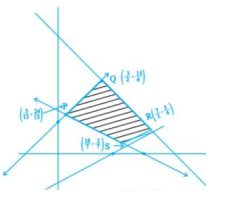
In Fig, the feasible region $($shaded$)$ for a $\text{LPP}$ is shown. Determine the maximum and minimum value of $Z =x+2y$
Image

Solve the Linear Programming Problem graphically:
Maximize $Z = 3x + 4y$ Subject to
$2 x+2 y \leq 80$
$2 x+4 y \leq 120$