Question
If $\vec{\text{a}}=2\hat{\text{i}}+5\hat{\text{j}}-7\hat{\text{k}},\vec{\text{b}}=-3\hat{\text{i}}+4\hat{\text{j}}+\hat{\text{k}}$ and $\vec{\text{c}}=\hat{\text{i}}-2\hat{\text{j}}-3\hat{\text{k}},$ compute $\big(\vec{\text{a}}\times\vec{\text{b}}\big)\times\vec{\text{c}}$ and $\vec{\text{a}}\times\big(\vec{\text{b}}\times\vec{\text{c}}\big)$ and verify that these are not equal.
Answer

Given:
$\vec{\text{a}}=2\hat{\text{i}}+5\hat{\text{j}}-7\hat{\text{k}}$
$\vec{\text{b}}=-3\hat{\text{i}}+4\hat{\text{j}}+\hat{\text{k}}$
$\vec{\text{c}}=\hat{\text{i}}-2\hat{\text{j}}-3\hat{\text{k}}$
$\therefore\vec{\text{a}}\times\vec{\text{b}}=\begin{vmatrix}\hat{\text{i}}&\hat{\text{j}}&\hat{\text{k}}\\2&5&-7\\-3&4&1 \end{vmatrix}$
$=(5+28)\hat{\text{i}}-(2-21)\hat{\text{j}}+(8+15)\hat{\text{k}}$
$=33\hat{\text{i}}+19\hat{\text{j}}+23\hat{\text{k}}$
$\Rightarrow\big(\vec{\text{a}}\times\vec{\text{b}}\big)\times\vec{\text{c}}=\begin{vmatrix}\hat{\text{i}}&\hat{\text{j}}&\hat{\text{k}}\\33&19&23\\1&-2&-3 \end{vmatrix}$
$=(-57+46)\hat{\text{i}}-(-99-23)\hat{\text{j}}+(-66-19)\hat{\text{k}}$
$\Rightarrow\big(\vec{\text{a}}\times\vec{\text{b}}\big)\times\vec{\text{c}}=-11\hat{\text{i}}+122\hat{\text{j}}-85\hat{\text{k}}\dots(1)$
$\therefore\vec{\text{b}}\times\vec{\text{c}}=\begin{vmatrix}\hat{\text{i}}&\hat{\text{j}}&\hat{\text{k}}\\-3&4&1\\1&-2&-3 \end{vmatrix}$
$=(-12+2)\hat{\text{i}}-(9-1)\hat{\text{j}}+(6-4)\hat{\text{k}}$
$=-10\hat{\text{i}}-8\hat{\text{j}}+2\hat{\text{k}}$
$\Rightarrow\vec{\text{a}}\times\big(\vec{\text{b}}\times\vec{\text{c}}\big)=\begin{vmatrix}\hat{\text{i}}&\hat{\text{j}}&\hat{\text{k}}\\2&5&-7\\-10&-8&2 \end{vmatrix}$
$=(10-56)\hat{\text{i}}-(4-70)\hat{\text{j}}+(-16+50)\hat{\text{k}}$
$\Rightarrow\vec{\text{a}}\times\big(\vec{\text{b}}\times\vec{\text{c}}\big)=-46\hat{\text{i}}+66\hat{\text{j}}+34\hat{\text{k}}\dots(2)$
From (1) and (2), we get
$\big(\vec{\text{a}}\times\vec{\text{b}}\big)\times\vec{\text{c}}\neq\vec{\text{a}}\times\big(\vec{\text{b}}\times\vec{\text{c}}\big)$

Need a full question paper?

Generate a complete, print-ready paper with questions like this in minutes — across 16+ boards, with answer keys.

Start Generating Free

Similar questions

In the following, determine the values of constants involved in the definition so that the given function is continuous:
$\text{f(x)}=\begin{cases}2,&\text{if }\text{ x}\leq3\\\text{ax}+\text{b},&\text{if }3<\text{ x}<5\\9,&\text{if }\text{ x}\geq5\end{cases}$
Using differentials, find the approximate values of the following:
$\sin\Big(\frac{22}{14}\Big)$
What are the values of $'a'$ for which $f(x) = a^x $ is increasing on $R?$
Which of the following functions are strictly decreasing on $\Big(0,\frac{\pi}{2}\Big)?$
  1. $\cos\text{x}$
  2. $\cos2\text{x}$
  3. $\cos3\text{x}$
  4. $\tan\text{x}$
Evaluate the following intregals:
$\int\frac{1}{2+\sin\text{x}+\cos\text{x}}\text{dx}$
Discuss the continuity of the f(x) at the indicated points f(x) = |x| + |x - 1| at x = 0, 1.
Find the equation of the curve through the point (1, 0) if the slope of the tangent to the curve at any point (x, y) is $\frac{\text{y}-1}{\text{x}^2+\text{x}}.$
Solve the following differential equation: $\cos^{2} x \frac{dy}{dx} + y = \tan x$
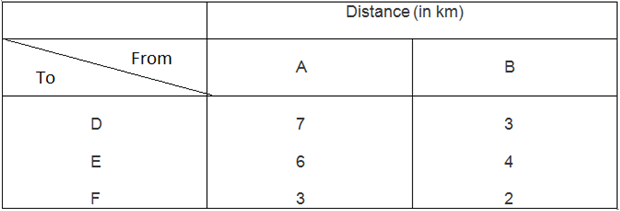
An oil company has two depots, $A$ and $B$, with capacities of $7000$ litres and $4000$  litres respectively. The company is to supply oil to three petrol pumps, $D, E, F$ whose requirements are $4500, 3000$ and $3500$ litres respectively. The distance (in km) between the depots and petrol pumps is given in the following table:

Assuming that the transportation cost per km is Rs. $1.00$ per litre, how should the delivery be scheduled in order that the transportation cost is minimum?
If y(x) is a solution of the different equation $\Big(\frac{2+\sin\text{x}}{1+\text{y}}\Big)\frac{\text{dy}}{\text{dx}}=-\cos\text{x}$ and $\text{y}(0)=1,$ then find the value of $\text{y}\Big(\frac{\pi}{2}\Big).$