If velocity of flow is $4 \,m / s$, then velocity head is .........$m$
Easy


Download our appand get started for free
Experience the future of education. Simply download our apps or reach out to us for more information. Let's shape the future of learning together!No signup needed.*
Similar Questions
- 1A fully loaded boeing aircraft has a mass of $5.4 \times 10^5\,kg$. Its total wing area is $500\,m ^2$. It is in level flight with a speed of $1080\,km / h$. If the density of air $\rho$ is $1.2\,kg\,m ^{-3}$, the fractional increase in the speed of the air on the upper surface of the wing relative to the lower surface in percentage will be $\left( g =10\,m / s ^2\right)$View Solution
- 2A long cylindrical vessel is half filled with a liquid. When the vessel is rotated about its own vertical axis, the liquid rises up near the wall. If the radius of vessel is $5\,cm$ and its rotational speed is $2$ rotations per second, then the difference in the heights between the centre and the sides, in $cm,$ will beView Solution
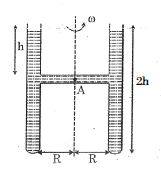
- 3The shown $H$ shaped apparatus contains an ideal incompressible liquid and has dimension as shown in figure . The diameters of the Tubes are small as compared to $h$ and $R$. The apparatus is rotated with a constant angular velocity $\omega$ about a symmetric vertical axis as shown in figure. The pressure at point $A$ isView Solution
- 4A body of density $\rho'$ is dropped from rest at a height $h$ into a lake of density $\rho$ , where $\rho > \rho '$ . Neglecting all dissipative forces, calculate the maximum depth to which the body sinks before returning to float on the surface.View Solution
- 5View SolutionA large ship can float but a steel needle sinks because of
- 6$Assertion :$ The buoyant force on a submerged rigid object can be considered to be acting at the centre of mass of the object.View Solution
$Reason :$ For a rigid body a force field distributed uniformly through its volume can be considered to be acting at the centre of mass of the body. - 7An aeroplane of mass $3 \times 10^4\,kg$ and total wing area of $120\,m^2$ is in a level flight at some height. The difference in pressure between the upper and lower surfaces of its wings in kilopascals is........... $kPa$ $(g=10\,m/s^2)$View Solution
- 8A heavy hollow cone of radius $R$ and height $h$ is placed on a horizontal table surface, with its flat base on the table. The whole volume inside the cone is filled with water of density $\rho$ . The circular rim of the cone’s base has a watertight seal with the table’s surface and the top apex of the cone has a small hole. Neglecting atmospheric pressure find the total upward force exerted by water on the cone isView Solution
- 9A spherical solid ball of volume $V$ is made of a material of density $\rho_1$ . It is falling through a liquid of density $\rho_2 (\rho_2 < \rho_1 )$. Assume that the liquid applies a viscous force on the ball that is proportional to the square of its speed $v$, i.e., $F_{viscous}= -kv^2 (k >0 )$,The terminal speed of the ball isView Solution
- 10Three identical vessels are filled with equal masses of three different liquids $A, B$ and $C$ $({\rho _A} > {\rho _B} > {\rho _C})$. The pressure at the base will beView Solution