Question
If we decrease the frequency of the applied $A.C.$ with a purely capacitive load, do $(1)$ the amplitude of $V_c$ and $(2)$ amplitude of $I_c$ increase, decrease of remain the same.

Answer

${X_c} = \frac{1}{{\omega _c\,}}$ and ${i_c} = \frac{{V_c}}{{X_c\,}}$

With decrease in frequency, $X_c$ increases and hence $i_c$ decreases.

Need a full question paper?

Generate a complete, print-ready paper with questions like this in minutes — across 16+ boards, with answer keys.
Start Generating Free

Similar questions

$X-$ rays region lies between
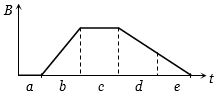
The graph gives the magnitude $B(t)$ of a uniform magnetic field that exists throughout a conducting loop, perpendicular to the plane of the loop. Rank the five regions of the graph according to the magnitude of the emf induced in the loop, greatest first
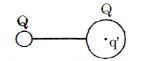
Two conducting hollow sphere of radius $R$ and $3R$ are found to have $Q$ charge on outer surface when both are connected with a long wire and $q'$ charge is kept at the centre of bigger sphere. Then which one is true
Green light of wavelength $5460 \mathring A$ is incident on an air-glass interface. If the refractive index of glass is $1.5$, the wave length of light in glass would be ........ $\mathring A$

$\left( c =3 \times 10^8 ms ^{-1}\right)$

Consider $a$ one-dimensional collision that involves $a$ body of mass $m_1$ originally moving in the positive $x$ direction with speed $v_0$ colliding with a second body of mass $m_2$ originally at rest. The collision could be completely inelastic, with the two bodies sticking together, completely elastic, or somewhere in between. After the collision, $m_1$ moves with velocity $v_1 $ while $m_2$ moves with velocity $v_2$.

$(A)$ $If \,m_1 > m_2$,

$(B)$ $If\, m_1 < m_2$,
An electron moving with a uniform velocity along the positive $x$-direction enters a magnetic field directed along the positive $y$-direction. The force on the electron is directed along
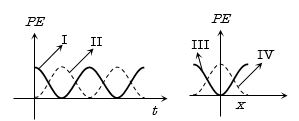
For a particle executing $S.H.M.$ the displacement $x$ is given by $x = A\cos \omega t$. Identify the graph which represents the variation of potential energy $(P.E.)$ as a function of time $t$ and displacement $x$
The $\alpha$-particle is the nucleus of an atom of
Focal length of a converging lens in air is $R.$ If it is dipped in water of refractive index $1.33, $ then its focal length will be around (Refractive index of lens material is $1.5$)
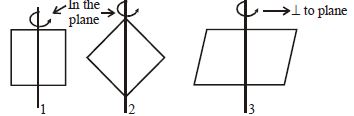
Three identical square plates rotate about the axes shown in the figure in such a way that their kinetic energies are equal. Each of the rotation axes passes through the centre of the square. Then the ratio of angular speeds $\omega _1 : \omega _2 : \omega _3$ is