MCQ
If we increase the driving frequency in a circuit with a purely resistive load, then amplitude $VR​.$
  • remain in the same
  • B
    increase
  • C
    decrease
  • D
    none

Answer

Correct option: A.
remain in the same

We know that $VR​$ does not depend on driving frequency in a purely resistive circuit. So, If we increase the driving frequency in a circuit with a purely resistive load, then amplitude remain in the same.

Need a full question paper?

Generate a complete, print-ready paper with questions like this in minutes — across 16+ boards, with answer keys.
Start Generating Free

Similar questions

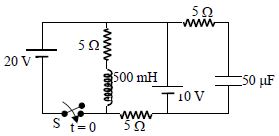
Switch $S$ is closed at $t = 0$, in the circuit shown. The change in flux in the inductor $(L=500\, mH)$ from $t = 0$ to an instant when it reaches steady state is ......$wb$
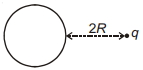
A positive point charge $q$ is placed at a distance $2 R$ from the surface of a metallic shell of radius $R$. The electric field at centre of shell due to induced charge has magnitude
Solid targets of different elements are bombarded by highly energetic electron beams. The frequency (f) of the characteristic X-rays emitted from different targets varies with atomic number Z as
The magnetic field at a distance r from a long wire carrying current i is 0.4 Tesla. The magnetic field at a distance 2r is
The output of a step-down transformer is measured to be $24V$ when connected to a $12$ watt light bulb. The value of the peak current is:
Two metal spheres $A$ and $B$ of radii $a$ and $b(a < b)$ respectively are at a large distance apart. Each sphere carries a charge of $100 \mu C$. The spheres are connected by a conducting wire, then
A semiconductor device is connected in a series circuit with a battery and a resistance. A current is found to pass through the circuit. If the polarity of the battery is reversed, the current drops almost to zero. The device may be
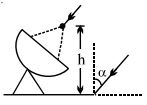
Radio waves coming at $\angle \, \alpha$ to vertical are recieved by a radar after reflection from a nearby water surface & directly. What should be height of antenna from water surface so that it records a maximum intensity. (wavelength $= \lambda$ ).
We wish to make a microscope with the help of two positive lenses both with a focal length of $20\, mm$ each and the object is positioned $25\, mm$ from the objective lens. How far apart the lenses should be so that the final image is formed at infinity?......$mm$
A $50 \,mH$ coil carries a current of $2$ ampere. The energy stored in joules is