MCQ
If $\mathrm{E}=\mathrm{at}+\mathrm{bt}^2$, what is the temperature of inversion
  • $-\frac{a}{2 b}$
  • B
    $+\frac{a}{2 b}$
  • C
    $-\frac{a}{b}$
  • D
    $+\frac{a}{b}$

Answer

Correct option: A.
$-\frac{a}{2 b}$
(a) $-\frac{a}{2 b}$

Need a full question paper?

Generate a complete, print-ready paper with questions like this in minutes — across 16+ boards, with answer keys.
Start Generating Free

Similar questions

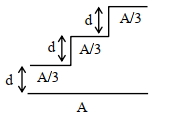
A capacitor is made of a tlat plate of area $A$ and a second plate having a stair-like structure as shown in figure. If the area of each stair is $\frac{A}{3}$ and the height is $\mathrm{d}$, the capacitance of the arrangement is:
Which one of the following is more monocromatic?
Two parallel wires in free space are 10 cm apart and each carries a current of 10 A in the same direction. The force one wire exerts on the other per metre of length is
Two points $P$ and $Q$ are maintained at the potentials of $10\, V$ and $-4\,V$, respectively. The work done in moving $100$ electrons from $P$ and $Q$ is
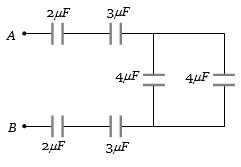
The effective capacity between $A$ and $B$ in the figure given is
A proton (mass m and charge +e) and an α - particle (mass 4m and charge +2e) are projected with the same kinetic energy at right angles to the uniform magnetic field. Which one of the following statements will be true
A particle of charge q and mass m moves in a circular orbit of radius r with angular speed ω. The ratio of the magnitude of its magnetic moment to that of its angular momentum depends on
There are four light-weight-rod samples $A, B, C, D$ separately suspended by threads. A bar magnet is slowly brought near each sample and the following observations are noted

$(i)$  $A$ is feebly repelled

$(ii)$ $B$ is feebly attracted

$(iii)$ $C$ is strongly attracted

$(iv)$ $D$ remains unaffected

Which one of the following is true?

When a comb rubbed with dry hair attracts pieces of paper. This is because the.
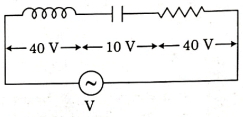
An inductor of inductance $L$, a capacitor of capacitance $\mathrm{C}$ and a resistor of resistance $'\mathrm{R}'$ are connected in series to an ac source of potential difference $'\mathrm{V}'$ volts as shown in figure.

Potential difference across $\mathrm{L}, \mathrm{C}$ and $\mathrm{R}$ is $40\, \mathrm{~V}$, $10\, \mathrm{~V}$ and $40\, \mathrm{~V}$, respectively. The amplitude of current flowing through $LCR$ series circuit is $10 \sqrt{2}\, \mathrm{~A} .$ The impedance of the circuit is .......... $\Omega$