MCQ
If $x \propto {t^{5/2}}$ , then
  • A
    $v \propto {t^{3/2}}$
  • B
    $a \propto \sqrt t $
  • both$ (A)$ and $(B)$
  • D
    $v \propto \sqrt t $

Answer

Correct option: C.
both$ (A)$ and $(B)$
c
Given $x \propto t^2 \quad \Rightarrow x= Kt ^2 \quad$ where $K = constant$

$\therefore$ Velocity of the particle $v =\frac{ dx }{ dt }=2 Kt$

$\therefore$ Acceleration of the particle $a =\frac{ dv }{ dt }=2 K = constant$

Need a full question paper?

Generate a complete, print-ready paper with questions like this in minutes — across 16+ boards, with answer keys.
Start Generating Free

Similar questions

The distance covered by a particle undergoing $SHM$ in one time period is (amplitude $= A$)
A ball is projected from ground with a speed of $20\,m / s$ at an angle of $45^{\circ}$ with horizontal. There is a wall of $25\,m$ height at a distance of $10\,m$ from the projection point. The ball will hit the wall at a height of $.........\,m$
An aluminium container of mass $100\,\, gm$ contains $200 \,\,gm$ of ice at $-20^o\,\, C$. Heat is added to the system at the rate of $100 \,\,cal/s$. The temperature of the system after $4$ minutes will be ....... $^oC$ (specific heat of ice $= 0.5$ and $L = 80 \,\,cal/gm$, specific heat of $Al= 0.2\,\, cal/gm/^o C$)
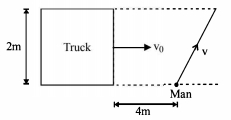
A $2\,m$ wide truck is moving with a uniform speed $v_0=8\,m / s$ along a straight horizontal road. A pedestrain starts to cross the road with a uniform speed $v$ when the truck is $4 m$ away from him. The minimum value of $v$ so that he can cross the road safely is $...........\frac{m}{s}$
The gravitational field due to a mass distribution is $E = K/{x^3}$ in the $X-$direction. ($K$ is a constant). Taking the gravitational potential to be zero at infinity, its value at a distance $X$ is
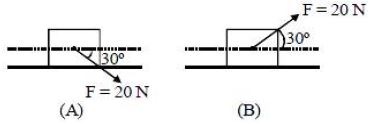
A block of mass $5\, kg$ is $(i)$ pushed in case $(A)$ and $(ii)$ pulled in case $(B)$, by a force $F = 20\, N$, making an angle of $30^o$ with the horizontal, as shown in the figures. The coefficient of friction between the block and floor is $\mu = 0.2$. The difference between the accelerations of the block, in case $(B)$ and case $(A)$ will be ........ $ms^{-2}$ .$(g = 10\, ms^{-2})$
Which of the following physical quantities do not have same dimensions?
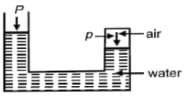
The pressure of confined air is $p$. If the atmospheric pressure is $P$, then
The specific heat capacity of a body depends on:
Two particles which are initially at rest, move towards each other under the action of their internal attraction. If their speeds are $v$ and $2v$ at any instant, then the speed of centre of mass of the system will be