MCQ
If $x, y, z$ are in arithmetic progression with common difference $d , x \neq 3 d ,$ and the
determinant of the matrix $\left[\begin{array}{ccc}3 & 4 \sqrt{2} & x \\ 4 & 5 \sqrt{2} & y \\ 5 & k & z\end{array}\right]$ is zero, then the value of $k ^{2}$ is ..... .
  • $72$
  • B
    $12$
  • C
    $36$
  • D
    $6$

Answer

Correct option: A.
$72$
a
$\left|\begin{array}{ccc}3 & 4 \sqrt{2} & x \\ 4 & 5 \sqrt{2} & y \\ 5 & k & z\end{array}\right|=0$

$R _{2} \rightarrow R _{1}+ R _{3}-2 R _{2}$

$\Rightarrow\left|\begin{array}{ccc}3 & 4 \sqrt{2} & x \\ 0 & k-6 \sqrt{2} & 0 \\ 5 & k & z\end{array}\right|=0$

$\Rightarrow(k-6 \sqrt{2})(3 z-5 x)=0$

if $3 z-5 x=0 \Rightarrow 3(x+2 d)-5 x=0$

$\Rightarrow x=3 d$ (Not possible)

$\Rightarrow k =6 \sqrt{2} \quad \Rightarrow k ^{2}=72$

Need a full question paper?

Generate a complete, print-ready paper with questions like this in minutes — across 16+ boards, with answer keys.

Start Generating Free

Similar questions

The area (in sq. units) of the region described by $A = \{ (x,y)|y \ge {x^2} - 5x + 4,\,x + y \ge 1,\,y \le 0\} $ is 
The Integrating Factor of the differential equation $\left( {1 - {y^2}} \right)\frac{{dx}}{{dy}} + yx = ay( - 1\, < \,y\, < \,1)$ is
If $\text{f}(\text{x})=\tan^{-1}(\text{g}(\text{x})),$ where g(x) is monotonically increasing for $0<\text{x}<\frac{\pi}{2}.$ Then, f(x) is:
  1. Increasing on $\Big(0,\frac{\pi}{2}\Big)$
  2. Decreasing on $\Big(0,\frac{\pi}{2}\Big)$
  3. Increasing on $\Big(0,\frac{\pi}{4}\Big)$ and decreasing on $\Big(\frac{\pi}{4},\frac{\pi}{2}\Big)$
  4. None of these.
If $\left[\begin{array}{ll}x+y & 2 x+z \\ x-y & 2 z+w\end{array}\right]=\left[\begin{array}{cc}4 & 7 \\ 0 & 10\end{array}\right]$, then the values of $x, y, z$ and $w$ respectively are
$\int_{ - 3}^3 {\frac{{{x^2}\sin 2x}}{{{x^2} + 1}}\,dx = } $
If the tangent to the curve x = at2, y = 2 at is perpendicular to x-axis, then its point of contact is:
  1. (a, a)
  2. (0, a)
  3. (0, 0)
  4. (a, 0)
$\int\limits^{2\text{a}}_0\text{f}(\text{x})\text{dx}$ is equal to:
  1. $2\int\limits^{\text{a}}_0\text{f(x)}\text{dx}$
  2. $0$
  3. $\int\limits^{\text{a}}_0\text{f}(\text{x})\text{dx}+\int\limits^{\text{a}}_0\text{f}(2\text{a}-\text{x})\text{dx}$
  4. $\int\limits^{\text{a}}_0\text{f}(\text{x})\text{dx}+\int\limits^{2\text{a}}_0\text{f}(2\text{a}-\text{x})\text{dx}$
If the law of motion in a straight line is $s = {1 \over 2}v\,t,$ then acceleration is
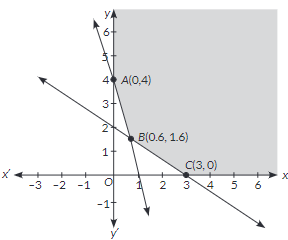
The corner points of the shaded unbounded feasible region of an LPP are $(0,4),(0.6,1.6)$ and $(3,0)$ as shown in the figure. The minimum value of the objective function $Z=4 x+6 y$ occurs at
Image
Consider the function. $f(x)=\left\{\begin{array}{cc} \frac{a\left(7 x-12-x^2\right)}{b\left|x^2-7 x+12\right|} & , x<3 \\ 2^{\frac{\sin (x-3)}{x-[x]}} & , x>3 \\ b & , x=3 \end{array}\right.$ Where $[\mathrm{x}]$ denotes the greatest integer less than or equal to $x$. If $S$ denotes the set of all ordered pairs $(a, b)$ such that $f(x)$ is continuous at $x=3$, then the number of elements in $\mathrm{S}$ is :