MCQ
If $x,\,2x + 2,\,3x + 3,$are in $G.P.$, then the fourth term is
  • A
    $27$
  • B
    $- 27$
  • C
    $13.5$
  • $- 13.5$

Answer

Correct option: D.
$- 13.5$
d
(d) Given that $x,\;2x + 2,\;3x + 3$ are in $G.P.$

Therefore, ${(2x + 2)^2} = x(3x + 3) $

$\Rightarrow {x^2} + 5x + 4 = 0$

$ \Rightarrow (x + 4)(x + 1) = 0$

$\Rightarrow x = - 1,\; - 4$

Now first term $a = x$

Second term $ar = 2(x + 1)$

$ \Rightarrow r = \frac{{2(x + 1)}}{x}$

then ${4^{th}}$ term $ = a{r^3}$$ = x{\left[ {\frac{{2(x + 1)}}{x}} \right]^3} = \frac{8}{{{x^2}}}{(x + 1)^3}$

Putting $x = - 4$

We get ${T_4} = \frac{8}{{16}}{( - 3)^3} = - \frac{{27}}{2} = - 13.5$.

Need a full question paper?

Generate a complete, print-ready paper with questions like this in minutes — across 16+ boards, with answer keys.
Start Generating Free

Similar questions

A cricket team has $15$ members, of whom only $5$ can bowl. If the names of the $15$ members are put into a hat and $11$ drawn at random, then the chance of obtaining an eleven containing at least $3$ bowlers is
If $sin (xy) + cos (xy) = 0$ then $\frac{{dy}}{{dx}}=$
$\int_{}^{} {\frac{{dx}}{{1 + x + {x^2} + {x^3}}} = } $
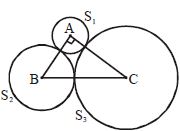
Figure shows $\Delta  ABC$ with $AB = 3, AC = 4$  &  $BC = 5$. Three circles $S_1, S_2$  &  $S_3$ have their centres on $A, B  $ &  $C$ respectively and they externally touches each other. The sum of areas of three circles is
$\int_{}^{} {\frac{{\log (x + \sqrt {1 + {x^2}} )}}{{\sqrt {1 + {x^2}} }}\;dx = } $
If the roots of the given equation $({m^2} + 1){x^2} + 2amx + {a^2} - {b^2} = 0$ be equal, then
If the circles ${x^2} + {y^2} - 9 = 0$ and ${x^2} + {y^2} + 2ax + 2y + 1 = 0$ touch each other, then $a =$
A box $B_1$ contains $1$ white ball, $3$ red balls and $2$ black balls. Another box $B_2$ contains $2$ white balls, $3$ red balls and $4$ black balls. A third bo $B _2$ contains $3$ white balls, $4$ red balls and $5$ black balls.

$1.$ If $1$ ball is drawn from each of the boxes $B_1, B_2$ and $B_3$, the probability that all $3$ drawn balls are of the same colour is

$(A)$ $\frac{82}{648}$ $(B)$ $\frac{90}{648}$ $(C)$ $\frac{558}{648}$ $(D)$ $\frac{566}{648}$

$2.$ If $2$ balls are drawn (without replacement) from a randomly selected box and one of the balls is white and the other ball is red, the probability that these $2$ balls are drawn from bo $B _2$ is

$(A)$ $\frac{116}{181}$ $(B)$ $\frac{126}{181}$ $(C)$ $\frac{65}{181}$ $(D)$ $\frac{55}{181}$

Give the answer question $1$ and $2.$

Let $S$ be set of all real numbers ; then on set $S$ relation $R$ defined as $R = \{\ (a, b) : 1 + ab > 0\ \}$ is
Let $x, y$ be real numbers such that $x>2 y>0$ and $2 \log (x-2 y)=\log x+\log y$  Then, the possible value(s) of $\frac{x}{y}$