Question
If $\text{x}=9-4\sqrt{5},$ find the value of $\text{x}^2-\frac{1}{\text{x}^2}.$

Answer

$\text{x}=9-4\sqrt{5}$
$\Rightarrow\frac{1}{\text{x}}=\frac{1}{9-4\sqrt{5}}=\frac{1}{9-4\sqrt{5}}\times\frac{9+4\sqrt{5}}{9+4\sqrt{5}}\\=\frac{9+4\sqrt{5}}{9^2-\big(4\sqrt{5}\big)^2}=\frac{9+4\sqrt{5}}{81-80}=9+4\sqrt{5}$
$\Rightarrow\text{x}+\frac{1}{\text{x}}=9-4\sqrt{5}+9+4\sqrt{5}=18$
$\Rightarrow\Big(\text{x}+\frac{1}{\text{x}}\Big)^2=18^2=324$
$\Rightarrow\Big(\text{x}^2+\frac{1}{\text{x}^2}\Big)^2+2\times\text{x}\times\frac{1}{\text{x}}=324$
$\Rightarrow\Big(\text{x}^2+\frac{1}{\text{x}^2}\Big)+2=324$
$\Rightarrow\Big(\text{x}^2+\frac{1}{\text{x}^2}\Big)=322$

Need a full question paper?

Generate a complete, print-ready paper with questions like this in minutes — across 16+ boards, with answer keys.

Start Generating Free

Similar questions

Following table shows a frequency distribution for the speed of cars passing through at a particular spot on a high way:
Class interval (km/ h)
Frequency
30-40
40-50
50-60
60-70
70-80
80-90
90-100
3
6
25
65
50
28
14
Draw a histogram and frequency polygon representing the data above.
Two lines are respectively perpendicular to two parallel lines. Show that they are parallel to each other.
If $\text{x}=9-4\sqrt{5},$ find the value of $\text{x}^2-\frac{1}{\text{x}^2}.$
A classroom is 10m long, 6.4m wide and 5m high. If each student be given 1.6m2 of the floor area, how many students can be accommodated in the room? How many cubic metres of air would each student get?
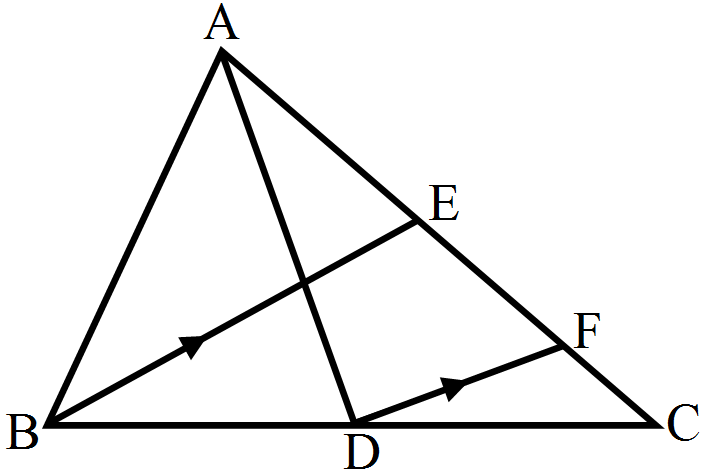
In the adjoining figure, AD and BE are the medians of $\triangle\text{ABC}$ and DF || BE. Show that $\text{CF}=\frac{1}{4}\text{AC}.$

Two circles of radii 5cm and 3cm intersect at two points and the distance between their centres is 4cm. Find the length of the common chord.
A measuring jar of internal diameter 10cm is partially filled with water. Four equal spherical balls of diameter 2cm each are dropped in it and they sink down in water completely. What will be the change in the level of water in the jar?
x4 - 2x3 - 7x2 + 8x + 12.
In a cyclic quadrilateral ABCD if $\text{m}\angle\text{A}=\big(\text{m}\angle\text{C}\big).$ Find $\text{m}\angle\text{A}.$ 
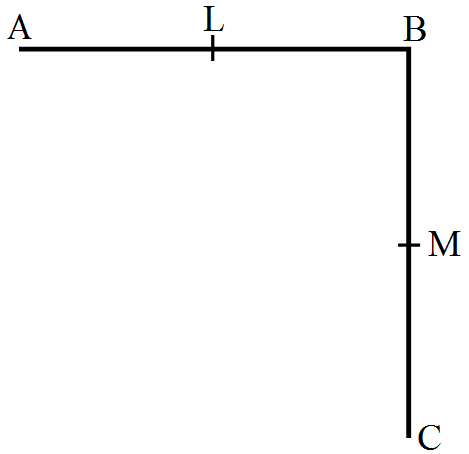
In the given figure, L and M are the mid-points of AB and BC respectively.

  1. If AB = BC, prove that AL = MC.
  2. If BL = BM, prove that AB = BC.
Hint:
  1. $\text{AB}=\text{BC}\Rightarrow\frac{1}{2}\text{AB}=\frac{1}{2}\text{BC}\Rightarrow\text{AL}=\text{MC}.$
  2. $\text{BL}=\text{BM}\Rightarrow2\text{BL}=2\text{BM}\Rightarrow\text{AB}=\text{BC}.$