MCQ
If $x+y=-4$, then $x^3+y^3-12 x y+64=$
  • A
    -64
  • B
    128
  • C
    0
  • D
    none of these

Answer

C. 0
$\begin{array}{l}\text { We have, } x+y=-4 \text { or, } x+y+4=0 . \\ \therefore \quad x^2+y^3+4^3=3 x y \times 4 \text { or, } x^3+y^3+64=12 x y \text { or, } x^3+y^3-12 x y+64=0\end{array}$

Need a full question paper?

Generate a complete, print-ready paper with questions like this in minutes — across 16+ boards, with answer keys.
Start Generating Free

Similar questions

Directions: In the following questions, the Assertions $(A)$ and Reason(s) $(R) $have been put forward. Read both the statements carefully and choose the correct alternative from the following:
Assertion: A cylinder and right circular cone are having the same base and same height the volume of cylinder is three times the volume of cone.
Reason: If the radius of cylinder is doubled and height is halved the volume will be doubled.
Two coins are tassed simultaneously. The probability of geeting atmost one head is:
A right circular cylinder and a right circular cone have the same radius and the same volume The ratio of the height of the cylinder to that of the cone is
The height of sand in a cylindrical shaped can drops $3$ inches when $1$ cubic foot of sand is poured out. What is the diameter, in inches, of the cylinder?
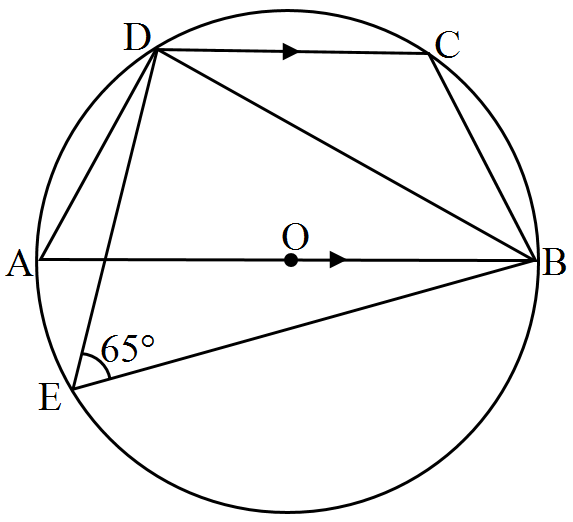
$AOB$ is the diameter of the circle. $ABCD$ is a cyclic trapezium in which $AB || DC.$ If $\angle\text{BED}=65^\circ,$ then $\angle\text{BDC}$ is equal to:
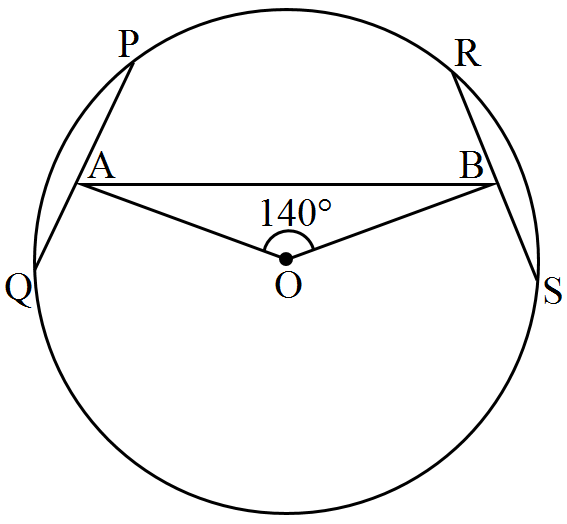
In the given figure $PQ$ and $RS$ are two equal chords of a circle with centre $O. OA$ and $OB$ are perpendiculars on chords $PQ$ and $RS,$ respectively. If $\angle\text{AOB}=140^\circ,$ then $\angle\text{PAB}$ is equal to.
The linear equation $3x - y = x - 1$ has:
In a $\triangle\text{ABC},$ if $3\angle\text{A}=4\angle\text{B}=6\angle\text{C}$ then $A : B : C =?$
In a triangle, an exterior angle at a vertex is $95^\circ $ and its one of the interior opposite angle is $55^\circ $, then the measure of the other interior angle is:
If $x + 1$ is a factor of the polynomial $2x^2 + kx,$ then $k =$