MCQ
If $y = \frac{x}{{\ln \,|c\,x|}}$ (where $c$ is an arbitrary constant) is the general solution of the differential equation $\frac{{dy}}{{dx}} =  \frac{y}{x}+  \phi \left( {\frac{x}{y}} \right)$ then the function $\phi \left( {\frac{x}{y}} \right)$ is :
  • A
    $\frac{{{x^2}}}{{{y^2}}}$
  • B
    $- \frac{{{x^2}}}{{{y^2}}}$
  • C
    $\frac{{{y^2}}}{{{x^2}}}$
  • $ - \frac{{{y^2}}}{{{x^2}}}$

Answer

Correct option: D.
$ - \frac{{{y^2}}}{{{x^2}}}$
d
$\ln c + \ln |x| = \frac{x}{y}$
diff. $w.r.t.\,\, x,\,\, \frac{1}{x} = \frac{{y - x\,{y_1}}}{{{y^2}}}$
$\frac{{{y^2}}}{x} = y - x\frac{{dy}}{{dx}}$
$\frac{{dy}}{{dx}} = \frac{y}{x} - \frac{{{y^2}}}{{{x^2}}}$
$\Rightarrow \phi \left( {\frac{x}{y}} \right) = - \frac{{{y^2}}}{{{x^2}}}$

Need a full question paper?

Generate a complete, print-ready paper with questions like this in minutes — across 16+ boards, with answer keys.

Start Generating Free

Similar questions

If $f(x) = \int\limits_0^x {\frac{1}{{\sqrt {1 + {t^3}} }}\,} dt$ and $h(x)$ is the inverse of $f(x)$ , then the value of $\frac{{h''(x)}}{{{h^2}(x)}}$ is
The maximum value of Z = 4x + 2y subject to the constraints $2\text{x}+3\text{y}\leq18,\text{x}+\text{y}\geq10,\text{x},\text{y}\leq0$ is:
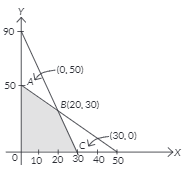
The maximum value of $Z=4 x+y$ for a L.P.P. whose feasible region is given below is:
Image
Let $u =$ $\int\limits_0^\infty  {\,\,\frac{{dx}}{{{x^4}\,\, + \,\,7{x^2}\,\, + \,\,1}}} $ & $v =$ $\int\limits_0^\infty  {\,\,\frac{{{x^2}\,\,\,\,dx}}{{{x^4}\,\, + \,\,7{x^2}\,\, + \,\,1}}} $ then :
$\int {{{\cos }^{ - 3/7}}} x{\sin ^{ - 11/7}}x\,\,dx = $
The domain of $f(x) = \frac{1}{{\sqrt {{{\log }_{\frac{\pi }{4}}}({{\sin }^{ - 1}}x) - 1} }}$,is
A flashlight has 8 batteries out of which 3 are dead. If two batteries are selected without replacement and tested, then probability that both are dead is
The projection of the vector $2i + j - 3k$ on the vector $i - 2j + k$is.....
Let $f: \mathrm{R} \rightarrow(0,1)$ be a continuous function. Then, which of the following function(s) has(have) the value zero at some point in the interval $(0,1)$ ?

$[A]$ $e^x-\int_0^x f(t) \sin t d t$   $[B]$ $x^9-f(x)$   $[C]$ $f(x)+\int_0^{\pi / 2} f(t) \sin t d t$

$[D]$ $x-\int_0^{\frac{\pi}{2}-x} f(t) \cos t d t$

Let $E$ and $F$ be two independent events. The probability that exactly one of them occurs is $\frac{11}{25}$ and the probability of none of them occurring is $\frac{2}{25}$. If $P(T)$ denotes the probability of occurrence of the event $T$, then

$(A)$ $P(E)=\frac{4}{5}, P(F)=\frac{3}{5}$

$(B)$ $P(E)=\frac{1}{5}, P(F)=\frac{2}{5}$

$(C)$ $P(E)=\frac{2}{5}, P(F)=\frac{1}{5}$

$(D)$ $P(E)=\frac{3}{5}, P(F)=\frac{4}{5}$