MCQ
If $y = f(x) = ax^2 + 2bx + c = 0$ has Imaginary roots and $4a + 4b + c < 0$ then :-
  • A
    $c>0$
  • $c<0$
  • C
    $c = 0$
  • D
    data insufficient

Answer

Correct option: B.
$c<0$
b
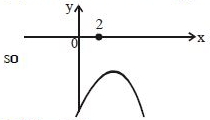
Let $f(x)=a x^{2}+b x+c$ has Imaginary Roots

$f(2)=4 a+4 b+c<0 \Rightarrow f(2)<0$

so $f(0) =c<0$
Need a full question paper?

Generate a complete, print-ready paper with questions like this in minutes — across 16+ boards, with answer keys.

Start Generating Free

Similar questions

Let $z_k=\cos \left(\frac{2 k \pi}{10}\right)+ i \sin \left(\frac{2 k \pi}{10}\right) ; k =1,2, \ldots 9$.

List $I$ List $II$
$P.$ For each $z_k$ there exists a $z_j$ such that $z_k \cdot z_j=1$ $1.$ True
$Q.$ There exists a $k \in\{1,2, \ldots ., 9\}$ such that $z_{1 .} . z=z_k$ has no solution $z$ in the set of complex numbers. $2.$ False
$R.$ $\frac{\left|1-z_1\right|\left|1-z_2\right| \ldots . .\left|1-z_9\right|}{10}$ equals $3.$ $1$
$S.$ $1-\sum_{k=1}^9 \cos \left(\frac{2 k \pi}{10}\right)$ equals $4.$ $2$

Codes: $ \quad P \quad Q \quad R \quad S$

The length intercepted by the curve ${y^2} = 4x$ on the line satisfying $dy/dx = 1$ and passing through point $(0, 1)$ is given by
If $\frac{\text{T}_{2}}{\text{T}_{3}}$ in the expansion of $(\text{a}+\text{b})^{\text{n}}$ and $\frac{\text{T}_{3}}{\text{T}_{4}}$ in the expansion of $(\text{a}+\text{b})^{\text{n}+3}$ are equal, then n =
Choose the correct answer. If $|x - 1| > 5,$ then:
The modal value is the value of the variate which divides the total frequency into two equal parts:
Let $b_i>1$ for $i=1,2, \ldots, 101$. Suppose $\log _e b_1, \log _e b_2, \ldots, \log _e b_{101}$ are in Arithmetic Progression ($A.P$.) with the common difference $\log _e 2$. Suppose $a_1, a_2, \ldots, a_{101}$ are in $A.P$. such that $a_1=b_1$ and $a_{51}=b_{51}$. If $t=b_1+b_2+\cdots+b_{51}$ and $s=a_1+a_2+\cdots+t_{65}$, then
The equation of the straight line passing through the point $(3, 2)$ and perpendicular to the line $y = x$ is:
Two parabolas have the same focus. If their directrices are the $x -$  axis $\&$ the $ y -$  axis respectively, then the slope of their common chord is :
The assumed mean of a distribution is $a$ and Arithmetic mean is $\bar{x},$ then its variance is :
There are $n$ different objects $1, 2, 3,......n$ distributed at random in $n$ places marked $1, 2, 3, ......n$. The probability that at least three of the objects occupy places corresponding to their number is