Question
If $y=a x^2+b$, then $\frac{d y}{d x}$ at $x=2$ is equal to

Answer

$(a) :$ We have, $y=a x^2+b$
$\Rightarrow \frac{d y}{d x}=2 a x$
$\left.\frac{d y}{d x}\right|_{x=2}=2 a \times 2=4 a$

Need a full question paper?

Generate a complete, print-ready paper with questions like this in minutes — across 16+ boards, with answer keys.
Start Generating Free

Similar questions

If $\tan^{-1}\Big\{\frac{\sqrt{1+\text{x}^2}-\sqrt{1-\text{x}^2}}{\sqrt{1+\text{x}^2}+\sqrt{1-\text{x}^2}}\Big\}=\alpha,$ then $x^2 =$
The area bounded by the curve $x^2+y^2=1$ in first quadrant is
Choose the correct answer from the given four options.If two events are independent, then:
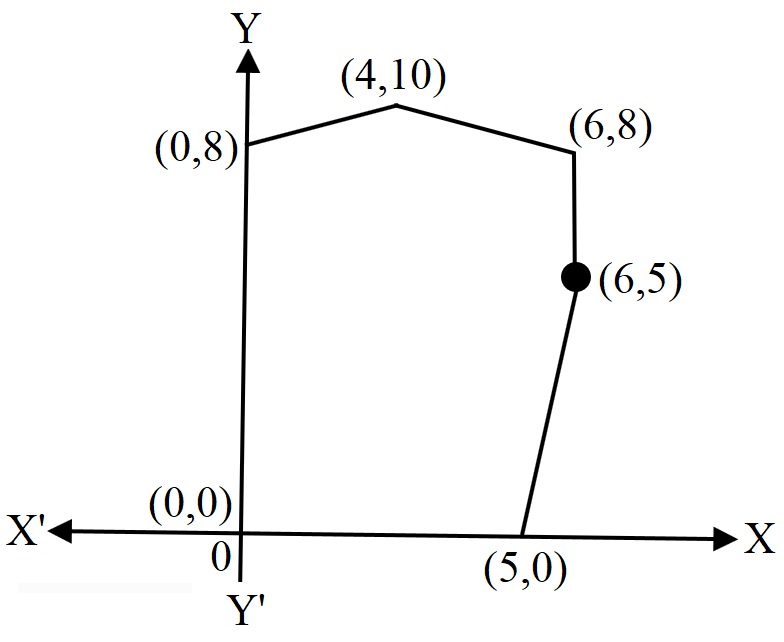
The feasible solution for a LPP is shown in the following figure. Let Z = 3x - 4y be the objective function.
Minimum of Z occurs at:
  1. (0, 0)
  2. (0, 8)
  3. (5, 0)
  4. (4, 10)
The Solution of $\cos(\text{x}+\text{y})\text{ dy}=\text{dx}$ is:
  1. $\text{y}=\tan\Big(\frac{\text{x}+\text{y}}{2}\Big)+\text{c}$
  2. $\text{y}=\cos^{-1}\Big(\frac{\text{y}}{\text{x}}\Big)+\text{c}$
  3. $\text{y}=\text{x}\sec\Big(\frac{\text{y}}{\text{x}}\Big)+\text{c}$
  4. $\text{None of these}$
If a line makes angles $Q_1, Q_{21}$ and $Q_3$ respectively with the coordinate axis then the value of $\cos^2 \text{Q}_{1} + \cos^2 \text{Q}_{2} + \cos^2 \text{Q}_{3}$:
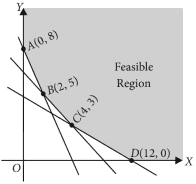
Feasible region for an L.P.P. is shown shaded in the following figure. Minimum of $Z=5 x+3 y$ occurs at the point point
Image
Let $\text{y}=\sqrt{\sin\text{x}+\text{y}},$ then $\frac{\text{dy}}{\text{dx}}=$
  1. $\frac{\sin\text{x}}{2\text{y}-1}$
  2. $\frac{\sin\text{x}}{1-2\text{y}}$
  3. $\frac{\cos\text{x}}{1-2\text{y}}$
  4. $\frac{\cos\text{x}}{2\text{y}-1}$
If a matrix P has 8 elements then how many different values the order of the matrix can take?
  1. 3
  2. 4
  3. 8
  4. 6
If $\text{P(A)}=\frac{2}{5},\text{P(B)}=\frac{3}{10}$ and $\text{P}(\text{A}\cap\text{B})=\frac{1}{5},$ then, $\text{P}(\overline{\text{A}}|\overline{\text{B}}) \text{ P}(\overline{\text{B}}|\overline{\text{A}})$ is equal to
  1. $\frac{5}{6}$
  2. $\frac{5}{7}$
  3. $\frac{25}{42}$
  4. $1$