Question
If $y=\log _e\left(\frac{x^2}{e^2}\right)$, then $\frac{d^2 y}{d x^2}$ equals

Answer

$\text { 84. (d) : We have, } y=\log _e\left(\frac{x^2}{e^2}\right)$
$\therefore \frac{d y}{d x}=\frac{e^2}{x^2} \cdot \frac{1}{e^2} \cdot 2 x=\frac{2}{x}$
$\Rightarrow \frac{d^2 y}{d x^2}=-\frac{2}{x^2}$

Need a full question paper?

Generate a complete, print-ready paper with questions like this in minutes — across 16+ boards, with answer keys.
Start Generating Free

Similar questions

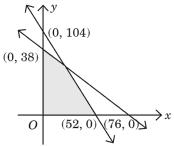
The feasible region of an LPP is given in the following figure
Image
Then, the constraints of the LPP are $x \geq 0, y \geq 0$ and
A zero vector has:
  1. Any direction
  2. No direction
  3. Many direction
  4. None of these
Evaluate: $\int_0^2(x-[x]) d x$
The equation of the normal to the curve $x = a \cos^3 \theta , y = a \sin^3 \theta$ at the point $\theta=\frac{\pi}{4}$ is:
$\cot\Big(\frac{\pi}{4}-2\cot^{-1}3\Big)=$
  1. 7
  2. 6
  3. 5
  4. none of these
If $\frac{\text{d}}{\text{dx}}[\text{x}^\text{n}-\text{a}_1\text{x}^{\text{n}-1}+\text{a}_2\text{x}^{\text{n}-2}+...+(-1)^\text{n}\text{a}_\text{n }]\text{e}^\text{x}=\text{x}^\text{n}\ \text{e}^\text{x},$ then the value of a, 0 < r < is equals to:
  1. $\frac{\text{n}!}{\text{r}!}$
  2. $\frac{(\text{n}-\text{r})!}{\text{r}!}$
  3. $\frac{\text{n}!}{(\text{n}-\text{r})!}$
  4. $\text{None of these}$
Evaluate: $\int\frac{1}{\sqrt{9+8\text{x}-\text{x}^2}}\text{dx}.$
  1. $-\sin^{-1}(\frac{\text{x}-4}{5})+\text{c}$
  2. $\sin^{-1}(\frac{\text{x}+4}{5})+\text{c}$
  3. $\sin^{-1}(\frac{\text{x}-4}{5})+\text{c}$
  4. $\text{None of there}$
The eqution of the plane contaning the two lines $\frac{\text{x}-1}{2}=\frac{\text{y}+1}{-1}=\frac{\text{z}-0}{3}$ and $\frac{\text{x}}{-2}=\frac{\text{y}-2}{-3}=\frac{\text{z}+1}{-1}$ is:
  1. 8x + y - 5z - 7 = 0
  2. 8x + y + 5z - 7 = 0
  3. 8x - y - 5z - 7 = 0
  4. None of these
Choose the correct answer from the given four options.
Corner points of the feasible region determined by the system of linear constraints are (0, 3), (1, 1) and (3, 0). Let Z = px + qy, where p, q > 0. Condition on p and q so that the minimum of Z occurs at (3, 0) and (1, 1) is:
  1. p = 2q
  2. $\text{p}=\frac{\text{q}}{2}$
  3. p = 3q
  4. p = q
Which of the following is correct:
  1. Determinant is a square matrix
  2. Determinant is a number associated to a matrix
  3. Determinant is a number associated to a square matrix
  4. None of these