Question
If $\text{y}=\log\sqrt{\frac{1+\tan\text{x}}{1-\tan\text{x}}},$ prove that $\frac{\text{dy}}{\text{dx}}=\sec2\text{x}$

Answer

We have, $\text{y}=\sqrt{\frac{1+\text{e}^\text{x}}{1-\text{e}^\text{x}}}$
Differentiating with respect to x,
$\frac{\text{dy}}{\text{dx}}=\frac{\text{d}}{\text{dx}}\Big(\sqrt{\frac{1+\text{e}^\text{x}}{1-\text{e}^\text{x}}}\Big)$
$=\frac{1}{\sqrt[2]{\Big(\frac{1+\text{e}^\text{x}}{1-\text{e}^\text{x}}\Big)}}\times\frac{\text{d}}{\text{dx}}\Big(\frac{1+\text{e}^\text{x}}{1-\text{e}^\text{x}}\Big)$
[Using chain rule]
$=\frac{1}{2}\times\sqrt{\frac{1-\text{e}^\text{x}}{1+\text{e}^\text{x}}}\Bigg[\frac{\big(1-\text{e}^\text{x}\frac{\text{d}}{\text{dx}}(1+\text{e}^\text{x})-(1+\text{e}^\text{x})\frac{\text{d}}{\text{dx}}(1-\text{e}^\text{x})\big)}{(1-\text{e}^\text{x})^2}\Bigg]$
$=\frac{1}{2}\sqrt{\frac{1-\text{e}^\text{x}}{1+\text{e}^\text{x}}}\bigg[\frac{(1-\text{e}^\text{x})\text{e}^\text{x}+(1+\text{e}^\text{x})\text{e}^\text{x}}{(1-\text{e}^\text{x})^2}\bigg]$
$=\frac{1}{2}\sqrt{\frac{1-\text{e}^\text{x}}{1+\text{e}^\text{x}}}\Big[\frac{2\text{e}^\text{x}}{(1-\text{e}^\text{x})^2}\Big]$
$=\frac{\text{e}^\text{x}}{\sqrt{(1+\text{e}^\text{x})\sqrt{(1+\text{e}^\text{x})}}}\frac{1}{(1-\text{e}^\text{x})}$
$\frac{\text{dy}}{\text{dx}}=\frac{\text{e}^\text{x}}{(1-\text{e}^\text{x})\sqrt{1-\text{e}^{2\text{x}}}}$

Need a full question paper?

Generate a complete, print-ready paper with questions like this in minutes — across 16+ boards, with answer keys.
Start Generating Free

Similar questions

Show that the following system of linear equations is consistent and also find solution:
x + y + z = 6
x + 2y + 3z = 14
x + 4y + 7z = 30
Differentiate the following functions with respect to x:
$\log\sqrt{\frac{1-\cos\text{x}}{1+\cos\text{x}}}$
Solve the following initial value problems:
$\frac{\text{dy}}{\text{dx}}+\text{y}\cot\text{x}=4\text{x }\text{cosec x},\text{ y}\Big(\frac{\pi}{2}\Big)=0$
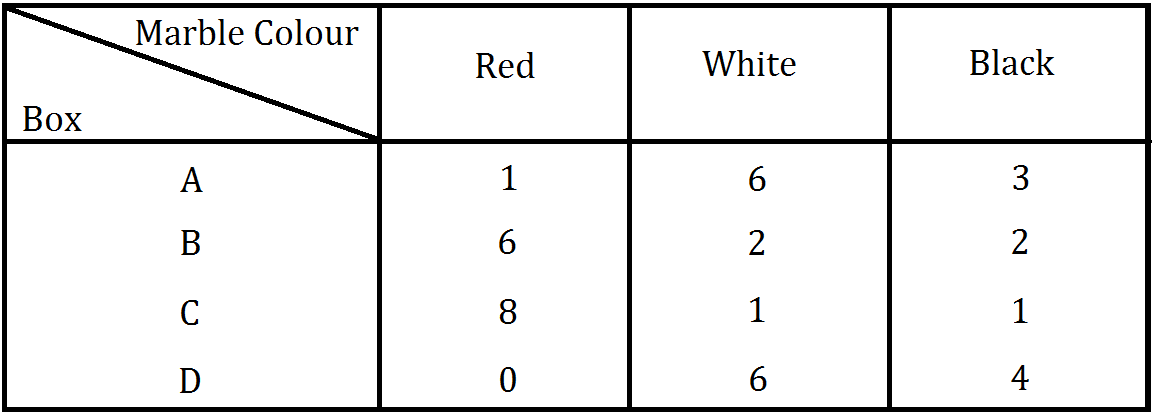
Suppose we have four boxes A, B, C, D containing coloured marbles as given below:

One of the boxes has been selected at random and a single marble is drawn from it. If the marble is red, what is the probability that it was drawn from,

  1. Box A?
  2. Box B?
  3. Box C?
Explain why the experiment of tossing a coin three times is said to have binomial distribution.
Let $\vec{\text{a}}=\hat{\text{i}}+4\hat{\text{j}}+2\hat{\text{k}},\vec{\text{b}}=3\hat{\text{i}}-2\hat{\text{j}}+7\hat{\text{k}}$ and  $\vec{\text{c}}=2\hat{\text{i}}-\hat{\text{j}}+4\hat{\text{k}}.$Find a vector $\vec{\text{d}}$ which is perpendicular to both $\vec{\text{a}}$ and $\vec{\text{d}}$ and $\vec{\text{c}}.\vec{\text{d}}=15.$
A large window has the shape of a rectangle surmounted by an equilateral triangle. If the perimeter of the window is 12 metres find the dimensions of the rectangle will produce the largest area of the window.
A chemical company produces two compounds, A and B. The following table gives the units of ingredients, C and D per kg of compounds A and B as well as minimum requirements of C and D and costs per kg of A and B. Find the quantities of A and B which would give a supply of C and D at a minimum cost.
 
Compound
Minimum requirement
A
B
 
Ingredient C
1
2
80
Ingredient D
3
1
75
Coist (in Rs.) per Kg
4
6
 
The rate of increase of bacteria in a culture is proportional to the number of bacteria present and it is found that the number doubles in 6 hours. Prove that the bacteria becomes 8 times at the end of 18 hours.
Solve the following differential equation:
$\frac{\text{dy}}{\text{dx}}+\text{y}\cos\text{x}=\sin\text{x}\cos\text{x}$