Question
If Young's double slit experiment is performed in water:
  1. The fringe width will decrease.
  2. The fringe width will increase.
  3. The fringe width will remain unchanged.
  4. There will be no fringe.

Answer

  1. The fringe width will decrease.
Explanation:
As fringe width is proportional to the wavelength and wavelength of light is inversely proportional to the refractive index of the medium,
Here,
$\lambda_\text{M}=\frac{\lambda}{\eta}$
$\lambda_\text{M}$ = wavelength in medium
$\lambda$ = wavelength in vacuum
$\eta$ = refractive index of medium
Hence, fringe width decreases when Young's double slit experiment is performed under water.

Need a full question paper?

Generate a complete, print-ready paper with questions like this in minutes — across 16+ boards, with answer keys.

Start Generating Free

Similar questions

A symmetric double convex lens is cut in two equal parts by a plane perpendicular to the principal axis. If the power of the original lens was $4D,$ the power of a cutlens will be$:$
Correct exposure for a photographic print is 10 seconds at a distance of one metre from a point source of 20 candela. For an equal fogging of the print placed at a distance of 2 m from a 16 candela source, the necessary time for exposure is(a) 100 sec(b) 25 sec(c) 50 sec   (d) 75 sec
       
Three resistances, each of $1$ ohm, are joined in parallel. Three such combinations are put in series, then the resultant resistance will be
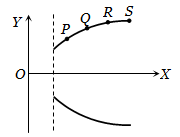
In a parabola spectrograph, the velocities of four positive ions $\text{P,Q,R}$ and $\ce{S}$ are $v_1, v_2, v_3$ and $v_4$ respectively
 
Assertion  :   When a magnetic dipole is placed in a non uniform magnetic field, only a torque acts on the dipole.
Reason      : Force would also acts on dipole if magnetic field were uniform.(a) If both assertion and reason are true and the reason is the correct explanation of the assertion.(b) If both assertion and reason are true but reason is not the correct explanation of the assertion.(c) If assertion is true but reason is false.(d) If the assertion and reason both are false.


The wavelength of a monochromatic light is 6000 Å in vacuum. When it enters in the glass slab of refractive index 2 its wavelength will be :
Among the two interfering monochromatic sources A and B; A is ahead of B in phase by 66°. If the observation be taken from point P, such that PB – PA = l/4. Then the phase difference between the waves from A and B reaching P is (a) 156°(b) 140°(c) 136°(d) 126°
       
Two bodies $A$ and $B$ of equal mass are suspended from two separate massless springs of spring constant $k_1$ and $k_2$ respectively. If the bodies oscillate vertically such that their maximum velocities are equal, the ratio of the amplitude of $A$ to that of $B$ is:
A parallel combination of two capacitors of capacitance $C_1$ and $C_2$ is given a charge $Q$. If there is $Q_1$ charge on $C_1$ and $Q_2$ charge on $C_2$, the ratio of $\frac{Q_1}{Q_2}$ will be:
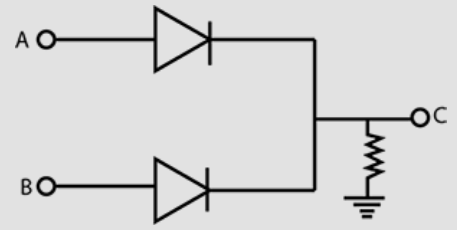
In the given circuit, if A and B represent two inputs and C represents the output, the circuit represents: