MCQ
If Young's double slit experiment is performed in water:
  • The fringe width will decrease.
  • B
    The fringe width will increase.
  • C
    The fringe width will remain unchanged.
  • D
    There will be no fringe.

Answer

Correct option: A.
The fringe width will decrease.
As fringe width is proportional to the wavelength and wavelength of light is inversely proportional to the refractive index of the medium,
Here,
$\lambda_\text{M}=\frac{\lambda}{\eta}$
$\lambda_\text{M}$ = wavelength in medium
$\lambda$ = wavelength in vacuum
$\eta$ = refractive index of medium
Hence, fringe width decreases when Young's double slit experiment is performed under water.

Need a full question paper?

Generate a complete, print-ready paper with questions like this in minutes — across 16+ boards, with answer keys.
Start Generating Free

Similar questions

If we study the vibration of a pipe open at both ends, then the following statement is not true.
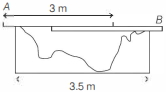
Persons $A$ and $B$ are standing on the opposite sides of a $3.5 \,m$ wide water stream which they wish to cross. Each one of them has a rigid wooden plank whose mass can be neglected. However, each plank is only slightly longer than $3 \,m$. So, they decide to arrange them together as shown in the figure schematically. With $B$ (mass $17 \,kg$ ) standing, the maximum mass of $A$, who can walk over the plank is close to ............ $kg$
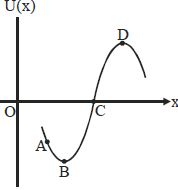
Potential energy of a particle varies with distance $x$ as shown in the graph Select the wrong statement
A brass rod of cross-sectional area $1\,c{m^2}$ and length $0.2\, m$ is compressed lengthwise by a weight of $5\, kg$. If Young's modulus of elasticity of brass is $1 \times {10^{11}}\,N/{m^2}$ and $g = 10\,m/{\sec ^2}$, then increase in the energy of the rod will be
A physical quantity $P$ is given as $P=\frac{a^2 b^3}{c \sqrt{d}}$ The percentage error in the measurement of $a, b, c$ and $d$ are $1 \%, 2 \%, 3 \%$ and $4 \%$ respectively. The percentage error in the measurement of quantity $P$ will be $.......\%$
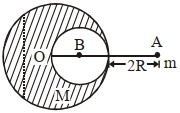
A solid sphere of radius $R$ gravitationally attracts a particle placed at $3 R$ form its centre with a force $F _{1}$. Now a spherical cavity of radius $\left(\frac{ R }{2}\right)$ is made in the sphere (as shown in figure) and the force becomes $F _{2}$. The value of $F _{1}: F _{2}$ is
The height $y$ and the distance $x$ along the horizontal plane of a projectile on a certain planet (with no surrounding atmosphere) are given by $y = (8t - 5{t^2})$ meter and $x = 6t\, meter$, where $t$ is in second., the acceleration due to gravity is given by ......... $m/{\sec ^2}$
Sound travels in a mixture of two moles of helium and n moles of hydrogen. If rms speed of gas molecules in the mixture is $\sqrt{2}$ times the speed of sound, then the value of $n$ will be
A particle has an initial velocity of ($3\hat i + 4\hat j)\;ms^{-1}$ and an acceleration of $(0.4\hat i + 0.3\hat j)\;ms^{-1}$ Its speed after $10\;s$ is:
Displacement of a particle of mass $2\, kg$ moving in a straight line varies with time as $s  = (2t^3 + 2)\, m$. Impulse of the force acting on the particle over a time interval between $t = 0$ and $t = 1\, s$ is .......... $N-s$