MCQ
If Young's modulus for a material is zero, then the state of material should be
  • A
    Solid
  • Solid but powder
  • C
    Gas
  • D
    None of the above

Answer

Correct option: B.
Solid but powder
b
(b) $Y$ is defined for solid only and for powders, $Y = 0$

Need a full question paper?

Generate a complete, print-ready paper with questions like this in minutes — across 16+ boards, with answer keys.
Start Generating Free

Similar questions

A ball falls vertically downward and bounces off a horizontal floor.The speed of the ball just before reaching the floor $\left(u_1\right)$ is equal to the speed just after leaving contact with the floor $\left(u_2\right), u_1=u_2$. The corresponding magnitudes of accelerations are denoted respectively by $a_1$ and $a_2$. The air resistance during motion is proportional to speed and is not negligible. If $g$ is acceleration due to gravity, then
The equation of a progressive wave is $y = a\,\sin \,\left( {\frac{\pi }{2}x - 200\pi t} \right)$ . The frequency of the wave will be .... $Hz$
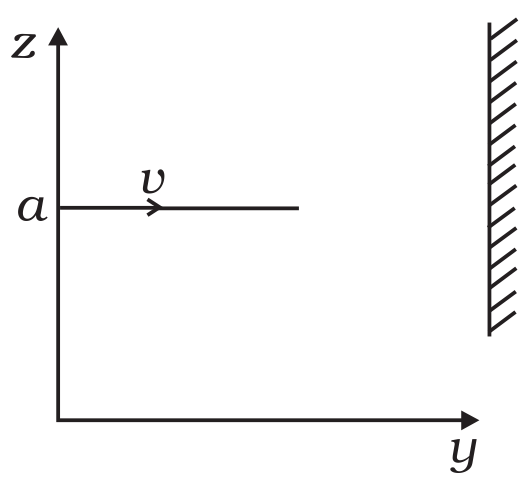
A particle of mass m is moving in yz-plane with a uniform velocity v with its trajectory running parallel to +ve y-axis and intersecting z-axis at z = a. The change in its angular momentum about the origin as it bounces elastically from a wall at y = constant is:

A wire suspended vertically from one end is stretched by attaching a weight $200 \,N$ to the lower end. The weight stretches the wire by $1 \,mm$. The elastic potential energy gained by the wire is ....... $J$
A tangential force $F$ is applied on a disc of radius $R$, due to which it deflects through an angle $\theta $ from its initial position. The work done by this force would be
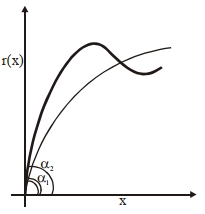
A projectile is launched from the origin in the $xy$ plane ( $x$ is the horizontal and $y$ is the vertically up direction) making an angle $\alpha$ from the $x$-axis. If its distance. $r =\sqrt{ x ^2+ y ^2}$ from the origin is plotted against $x$, the resulting curves show different behaviours for launch angles $\alpha_1$ and $\alpha_2$ as shown in the figure below. For $\alpha_1, r ( x )$ keeps increasing with $x$ while for $\alpha_2$, $r(x)$ increases and reaches a maximum, then decreases and goes through a minimum before increasing again. The switch between these two cases takes place at an angle $\alpha_c\left(\alpha_1 < \alpha_c < \alpha_2\right)$. The value of $\alpha_c$ is [ignore where $v_0$ is the initial speed of the projectile and $g$ is the acceleration due to gravity]
The weight of an object in the coal mine, sea level, at the top of the mountain are ${W_1},\;{W_2}$ and ${W_3}$ respectively, then
A sphere of mass $M$ and radius $r$ slips on a rough horizontal plane. At some instant it has translational velocity $V_0$ and rotational velocity about the centre $\frac{V_0}{2r}$  . The translational velocity when the sphere starts pure rolling motion is
A surface of area $S$ is placed perpendicular to the direction of travel of a plane wave. The energy per unit time intercepted by the surface is $E$ when the amplitude of the wave is $A$ . The area of the surface is reduced to $\frac{1}{2} \ S$ and the amplitude of the wave is increased to $2\ A$ . What is the energy per unit time intercepted by this smaller surface?
A clock which keeps correct time at ${20^o}C$, is subjected to ${40^o}C$. If coefficient of linear expansion of the pendulum is $12 \times {10^{ - 6}}/^\circ C$. How much will it gain or loose in time