Question
If $y=\tan x^2$ then $\frac{d y}{d x}=$……..

Answer

self

Need a full question paper?

Generate a complete, print-ready paper with questions like this in minutes — across 16+ boards, with answer keys.
Start Generating Free

Similar questions

Those problems in which an attempt is made to discover maximization of profit and minimization of cost are called _________ .
Fill in the blanks.
The values of k for which $|\text{k}\vec{\text{a}}|<|\vec{\text{a}}|$ and $\text{k}\vec{\text{a}}=\frac{1}{2}\vec{{\text{a}}}$ is a parallel to $\vec{\text{a}}$ holds true are _________.
Fill in the blanks:
If A is a matrix of order $3 × 3$, then $(A^2)^{-1} =$ ________.
Fill in the blank.
If A is symmetric matrix, then B′AB is _________.
Fill in the blank.
Sum of two skew symmetric matrices is always _________ matrix.
Fill in the blanks.
If $\vec{\text{r}}\cdot\vec{\text{a}}=0,\vec{\text{r}}\cdot\vec{\text{b}}=0,$ and $\vec{\text{r}}\cdot\vec{\text{c}}=0$ for some non-zero vector $\vec{\text{r}},$ then the value of $\vec{\text{a}}(\vec{\text{b}}\times\vec{\text{c}})$ is _______.
Fill in the blanks.
The vector equation of the line through the points (3, 4, -7) and (1, -1, 6) is __________.
The area between the curve $y^2=4 a x$, line $y=2 a$ and $y$-axis will be ____________.
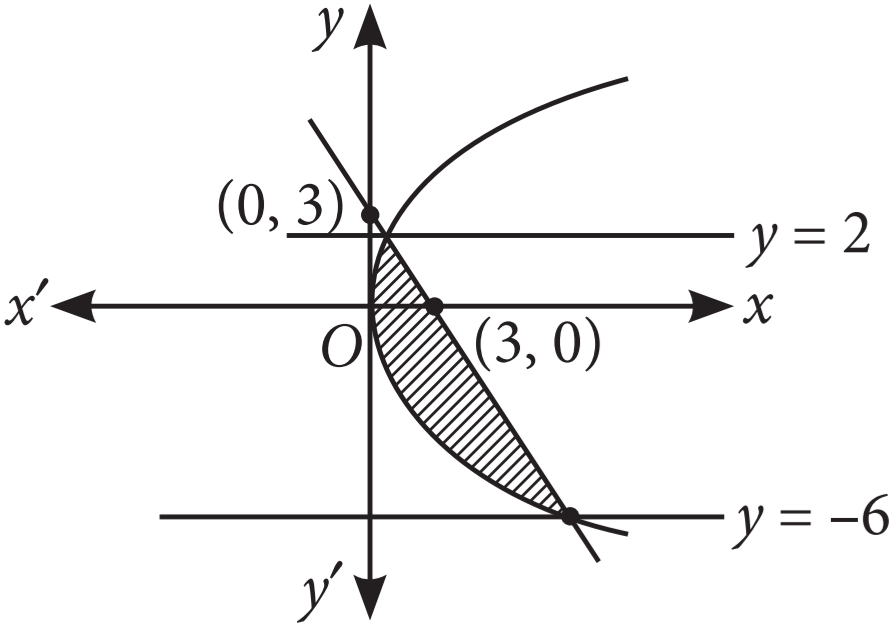
Consider the following equation of curve $y^2= 4x$ and straight line $x + y = 3.$
Based on the above information, answer the following questions.
  1. The line x + y = 3 cuts the x-axis and y-axis respectively at.
  1. $(0, 2), (2, 0)$
  2. $(3, 3), (0, 0)$
  3. $(0, 3), (3, 0)$
  4. $(3, 0), (0, 3)$
  1. Point(s) of intersection of two given curves is (are).
  1. $(1, -2), (-9, 6)$
  2. $(2, 1), (-6, 9)$
  3. $(1, 2), (9, -6)$
  4. None of these.
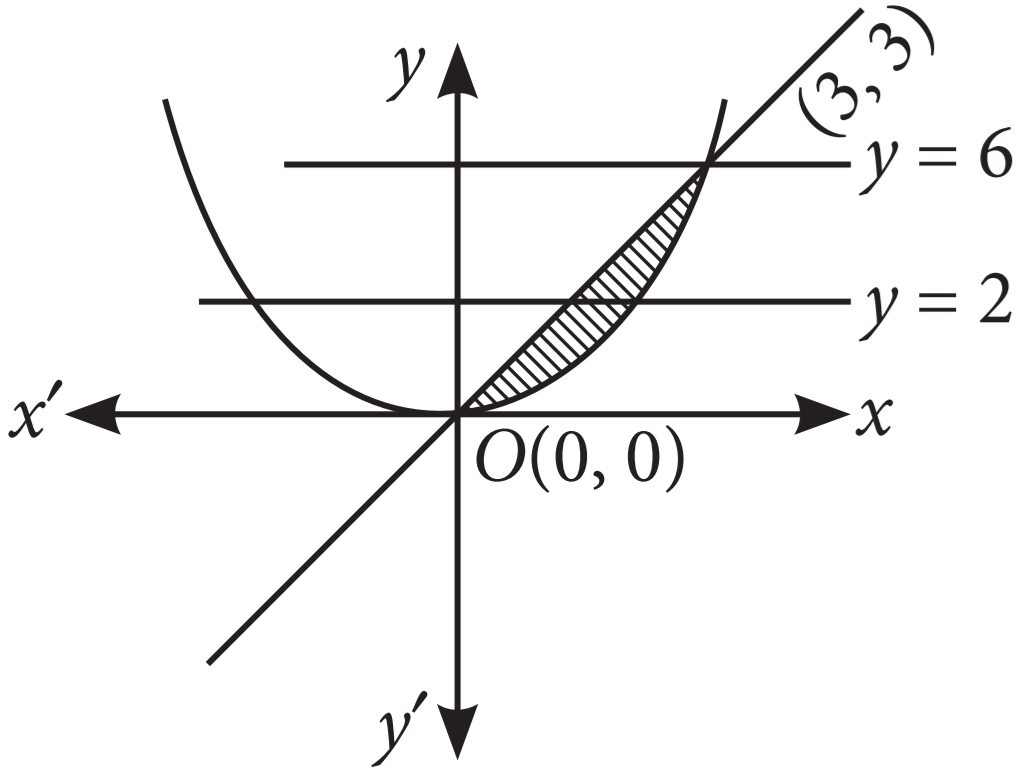
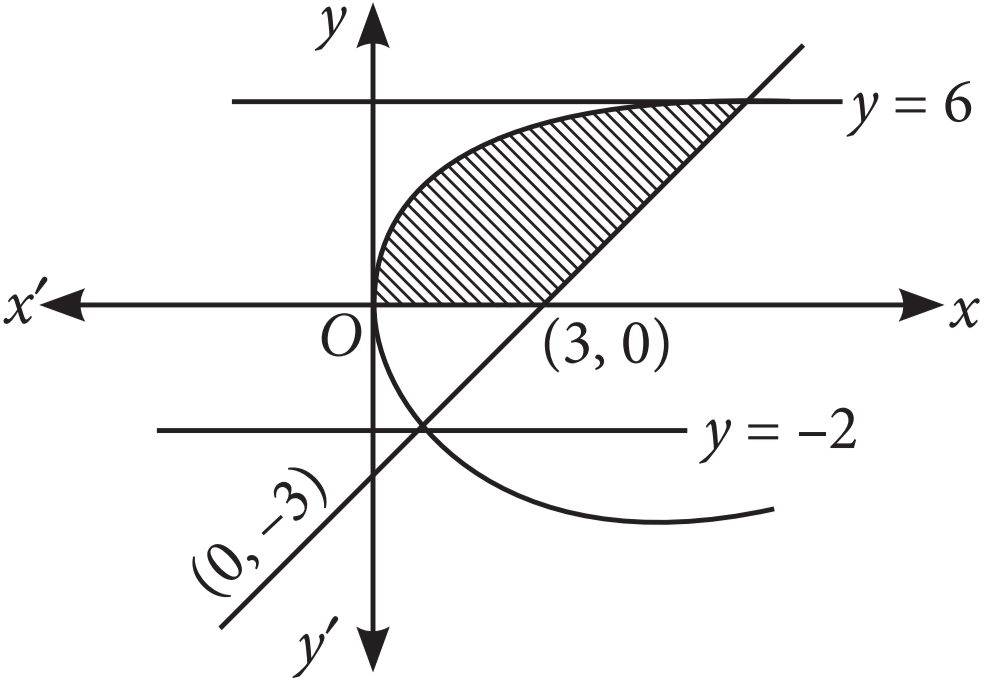
  1. Which of the following shaded portion re present the area bounded by given curves?
    1. None of these
  1. Value of the integral $\int\limits_{-6}^{2}(3-\text{y})\text{ dy}$ is
  1. $10$
  2. $20$
  3. $30$
  4. $40$
  1. Value of area bounded by given curves is.
  1. $56\text{ sq.units}$
  2. $\frac{63}{5}\text{ sq. units}$
  3. $\frac{64}{3}\text{ sq. units}$
  4. $31\text{ sq.units}$
The value of $\int x \cdot e^x d x$ will be