MCQ
If $z$ is a complex number such that $\frac{z-i}{z-1}$ is purely imaginary, then the minimum value of $\mid \mathrm{z}-(3+3 \mathrm{i}) \mid$ is :
  • A
    $2 \sqrt{2}-1$
  • B
    $3 \sqrt{2}$
  • C
    $6 \sqrt{2}$
  • $2 \sqrt{2}$

Answer

Correct option: D.
$2 \sqrt{2}$
d
$\frac{z-i}{z-1}$ is purely Imaginary number

Let $z=x+$ iy

$\therefore \frac{x+i(y-1)}{(x-1)+i(y)} \times \frac{(x-1)-i y}{(x-1)-i y}$

$\Rightarrow \frac{x(x-1)+y(y-1)+i(-y-x+1)}{(x-1)^{2}+y^{2}}$ is purely

Imaginary number

$\Rightarrow \mathrm{x}(\mathrm{x}-1)+\mathrm{y}(\mathrm{y}-1)=0$

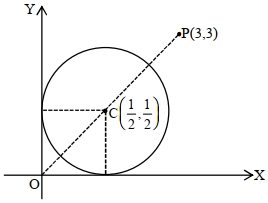
$\Rightarrow\left(\mathrm{x}-\frac{1}{2}\right)^{2}+\left(\mathrm{y}-\frac{1}{2}\right)^{2}=\frac{1}{2}$

$\therefore|z-(3+3 i)|_{\min } =\mid \mathrm{PCl}-\frac{1}{\sqrt{2}}$

$\quad\quad\quad\quad\quad\quad\quad\quad=\frac{5}{\sqrt{2}}-\frac{1}{\sqrt{2}}=2 \sqrt{2}$
Need a full question paper?

Generate a complete, print-ready paper with questions like this in minutes — across 16+ boards, with answer keys.

Start Generating Free

Similar questions

If $1+\frac{\sqrt{3}-\sqrt{2}}{2 \sqrt{3}}+\frac{5-2 \sqrt{6}}{18}+\frac{9 \sqrt{3}-11 \sqrt{2}}{36 \sqrt{3}}+\frac{49-20 \sqrt{6}}{180}+\ldots$

upto $\infty=2\left(\sqrt{\frac{b}{a}}+1\right) \log _e\left(\frac{a}{b}\right)$, where $a$ and $b$ are integers with $\operatorname{gcd}(a, b)=1$, then $11 a+18 b$ is equal to ...............
$2.\mathop {357}\limits^{ \bullet \,\, \bullet \,\, \bullet } = $
The value of $cot\, 7\frac{{{1^0}}}{2}$ $+ tan\, 67 \frac{{{1^0}}}{2} - cot 67 \frac{{{1^0}}}{2} - tan7 \frac{{{1^0}}}{2}$ is :
The number of ways in which 10 different diamonds can be arranged to form a necklace, is:
If ${s_n} = 1 + \frac{1}{2} + \frac{1}{{{2^2}}} + ........ + \frac{1}{{{2^{n - 1}}}}$ , then the least integral value of $n$ such that $2 - {s_n} < \frac{1}{{100}}$ is
A batsman scores runs in 10 innings as 38, 70, 48, 34, 42, 55, 63, 46, 54 and 44. The mean deviation about mean is:
$\lim _{x \rightarrow \frac{\pi}{4}} \frac{8 \sqrt{2}-(\cos x+\sin x)^{7}}{\sqrt{2}-\sqrt{2} \sin 2 x}$ is equal to
A straight line passing through $P(3, 1)$ meet the coordinates axes at $A$ and $B$. It is given that distance of this straight line from the origin $'O'$ is maximum. Area of triangle $OAB$ is equal to
If the constant term in the expansion of $\left(1+2 x-3 x^3\right)\left(\frac{3}{2} x^2-\frac{1}{3 x}\right)^9$ is $p$, then $108$ p is equal to....................
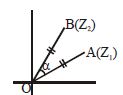
Let $z_1$, $z_2$ are the two complex number and roots of the equation $z^2 + az + b = 0$ and $O$ is the origin, such that $OA = OB$ and ${a^2} = \lambda b{\ \cos ^2}\ \frac{\alpha }{2}$, then $\lambda$ is equal to