MCQ
Image formed by a convex mirror is
  • Virtual
  • B
    Real
  • C
    Enlarged
  • D
    Inverted

Answer

Correct option: A.
Virtual
a
(a) Image formed by convex mirror is virtual for real object placed anywhere.

Need a full question paper?

Generate a complete, print-ready paper with questions like this in minutes — across 16+ boards, with answer keys.
Start Generating Free

Similar questions

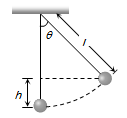
A simple pendulum with bob of mass m and conducting wire of length L swings under gravity through an angle 2θ. The earth’s magnetic field component in the direction perpendicular to swing is B. Maximum potential difference induced across the pendulum is

$64$ identical drops each charged upto potential of $10\,mV$ are combined to form a bigger dorp. The potential of the bigger drop will be $..........\,mV$
A coil of wire of a certain radius has $100$ turns and a self$-$inductance of $15\ mH.$ The self$-$inductance of a second similar coil of $500$ turns will be:
Which of the following quantities do not depend on the choice of zero potential or zero potential energy?
An electric dipole of moment p is placed in the position of stable equilibrium in uniform electric field of intensity E. It is rotated through an angle θ from the initial position. The potential energy of electric dipole in the final position is
An electromagnetic wave in vacuum has the electric and magnetic field $\vec E$ and $\vec B$ , which are always perpendicular to each other. The direction of polarization is given by $\vec X$ and that of wave propagation by $\vec k$ . Then
A paramagnetic sample shows a net magnetization of $8\ Am^{-1}$ when placed in an external magnetic field of $0.6\ T$ at a temperature of $4\ K$ . When the same sample is placed in an external magnetic field of $0.2\ T$ at a temperature of $16\ K$ , the magnetization will be
Two waves have their amplitudes in the ratio 1 : 9. The maximum and minimum intensities when they interfere are in the ratio 
Let r be the distance of a point on the axis of a bar magnet from its centre. The magnetic field at such a point is proportional to:
Electric field at a point $(x, y, z)$ is represented by $\vec E = 2x\hat i + {y^2}\hat j$ if potential at $(0,0,0)$ is $2\, volt$ find potential at $(1, 1, 1)$