MCQ
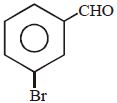
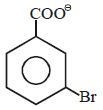
(image) $\xrightarrow[{\mathop {NaOH}\limits_{\left( {50\,\% } \right)} }]{{conc.}}{\text{Product}},$ Product
- ✓
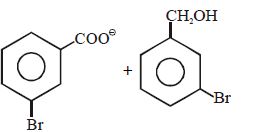
- B
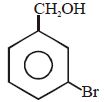
- C
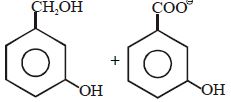
- D
Generate a complete, print-ready paper with questions like this in minutes — across 16+ boards, with answer keys.
$(a)$ Peroxide ion as well as dioxygen molecule both are paramagnetic species
$(b)$ In set of isomers, $[Cr(H_2O)_6]Cl_3$ and $[CrCl(H_2O) _5]Cl_2 . H_2O,$ both compounds can easily loose water molecule on treatment with cone. $H_2SO_4$
$(c)$ During transformation $NO \to NO^+$ , bond length and magnetic behaviour decreases
$(d)$ An ether is more volatile than alcohol both having same molecular formula
Reason : Phosphorus has lower electronegativity than nitrogen.
$\begin{array}{*{20}{c}}
O \\
{||} \\
{C{H_3} - C - C{H_3}}
\end{array}\mathop {\xrightarrow{{Conc.{H_2}S{O_4}}}}\limits_{Distillation} [X]$
$[X]$ will be :

Reason : Hydrogen is present above $Cu$ in the reactivity series.
| List $I$ Reaction | List $II$ Reagents |
| $A$ Hoffmann Degradation | $I$ Conc.KOH,$\Delta$ |
| $B$ Clemenson reduction | $II$ $CHCl _3, NaOH / H _3 O ^{+}$ |
| $C$ Cannizaro reaction | $III$ $Br _2, NaOH$ |
| $D$ Reimer-Tiemann reaction | $IV$ $Zn - Hg / HCl$ |