MCQ
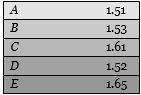
Immiscible transparent liquids $A, B, C, D$ and $E$ are placed in a rectangular container of glass with the liquids making layers according to their densities. The refractive index of the liquids are shown in the adjoining diagram. The container is illuminated from the side and a small piece of glass having refractive index $1.61$ is gently dropped into the liquid layer. The glass piece as it descends downwards will not be visible in
  • A
    Liquid $A$ and $B$ only
  • Liquid $C$ only
  • C
    Liquid $D$ and $E$ only
  • D
    Liquid $A, B, D$ and $ E$

Answer

Correct option: B.
Liquid $C$ only
b
(b) Refractive index of liquid $C$ is same as that of glass piece.

So it will not be visible in liquid $C$.

Need a full question paper?

Generate a complete, print-ready paper with questions like this in minutes — across 16+ boards, with answer keys.

Start Generating Free

Similar questions

A mass $m = 1.0\,kg$ is put on a flat pan attached to a vertical spring fixed on the ground. The mass of the spring and the pan is negligible. When pressed slightly and released, the mass executes simple harmonic motion. The spring constant is $500\,N/m.$ What is the amplitude $A$ of the motion, so that the mass $m$ tends to get detached from the pan ? (Take $g = 10\,m/s^2$ ). The spring is stiff enough so that it does not get distorted during the motion.
The tones that are separated by three octaves have a frequency ratio of
Angle of prism is $10^o.$  This refractive index for red and violet colours is $1.51$ and $1.52$ respectively. find the dispersive power
$P-V$ diagram of a diatomic gas is a straight line passing through origin. The molar heat capacity of the gas in the process will be 
A spring of spring constant $ 5 \times 10^3$ $ N/m$  is stretched initially by $5\,cm$ from the unstretched position. Then the work required to stretch it further by another $5\,cm$ is .............. $\mathrm{N-m}$
A man can jump to a height of $1.5 \,m$ on a planet $A$. What is the height he may be able to jump on another planet whose density and radius are, respectively, one-quarter and one-third that of planet $A$ .......  $m$
Two waves of amplitudes $A_0$ and $x A_0$ pass through a region. If $x > j _0$ the difference in the maximum and minimum resultant amplitude possible is
The moment of inertia of a triangular plate $ABC$ of mass $M$ and side $BC = a,$ about an axis passing through $A$ and perpendicular to the plane of the plate is :-
Glass has refractive index $\mu $ with respect to air and the critical angle for a ray of light going from glass to air is $\theta$. If a ray of light is incident from air on the glass with angle of incidence $\theta$, the corresponding angle of refraction is
A loop of light inextensible string passes over smooth small pulleys $A$ and $B$. Two masses $m$ and $M$ are attached to the points $O$ and $C$ respectively. Then the condition that $m$ and $M$ will cross each other. [Take $AB = 2l$ and $AC = AB = \eta l$] will be