MCQ
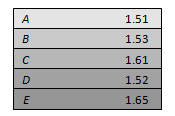
Immiscible transparent liquids $A, B, C, D$ and $E$ are placed in a rectangular container of glass with the liquids making layers according to their densities. The refractive index of the liquids are shown in the adjoining diagram. The container is illuminated from the side and a small piece of glass having refractive index $1.61$ is gently dropped into the liquid layer. The glass piece as it descends downwards will not be visible in
  • A
    Liquid $A$ and $B$ only
  • Liquid $C$ only
  • C
    Liquid $D$ and $E$ only
  • D
    Liquid $A, B, D$ and $E$

Answer

Correct option: B.
Liquid $C$ only
Liquid $C$ only

Need a full question paper?

Generate a complete, print-ready paper with questions like this in minutes — across 16+ boards, with answer keys.

Start Generating Free

Similar questions

For television broadcasting, the frequency employed is normally(a) 30-300 MHz(b) 30-300 GHz(c) 30-300 KHz(d) 30-300 Hz
       
In a moving coil galvanometer, the deflection of the coil $\theta$ is related to the elecrical current i by the relation:
The largest distance between the interatomic planes of a crystal is $10^{-7}\ cm$. The upper limit for the wavelength of $X-$rays which can be usefully studied with this crystal is
If $\mu_c$ and $\mu_h$ are electron and hole mobility $,E$ be the applied electric field, the current density $j$ for intrinsic semiconductor is equal to
A ball hits a floor and rebounds after an inelastic collision. In this case:
  1. The momentum of the ball just after the collision is same as that just before the collision.
  2. The mechanical energy of the ball remains the same during the collision.
  3. The total momentum of the ball and the earth is conserved.
  4. The total energy of the ball and the earth remains the same.
A barometer kept in an elevator reads 76cm when it is at rest. If the elevator goes up with increasing speed, the reading will be:
  1. zero.
  2. 76cm.
  3. < 76cm.
  4. > 76cm.
Two bodies at different temperatures are mixed in a calorimeter. Which of the following quantities remains conserved?
  1. Sum of the temperatures of the two bodies.
  2. Total heat of the two bodies.
  3. Total internal energy of the two bodies.
  4. Internal energy of each body.
What name is given to a cylindrical coil of diameter less than its length?
Total internal reflection of light is possible when light enters from(a) Air to glass(b) Vacuum to air(c) Air to water(d) Water to air
       
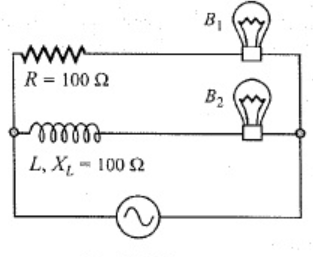
In the figure two identical bulbs, each with filament resistance $100\Omega$ are connected to a resistor $\text{R}=100\Omega$ and an inductor $(\text{X}_\text{L}=100\Omega)$ as shown in the Figure. Then, which bulb glows more.
Image