MCQ
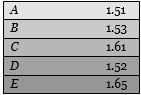
Immiscible transparent liquids $A, B, C, D$ and $E$ are placed in a rectangular container of glass with the liquids making layers according to their densities. The refractive index of the liquids are shown in the adjoining diagram. The container is illuminated from the side and a small piece of glass having refractive index $1.61$ is gently dropped into the liquid layer. The glass piece as it descends downwards will not be visible in
  • A
    Liquid $A$ and $B$ only
  • Liquid $C$ only
  • C
    Liquid $D$ and $E$ only
  • D
    Liquid $A, B, D$ and $ E$

Answer

Correct option: B.
Liquid $C$ only
b
(b) Refractive index of liquid $C$ is same as that of glass piece.

So it will not be visible in liquid $C$.

Need a full question paper?

Generate a complete, print-ready paper with questions like this in minutes — across 16+ boards, with answer keys.

Start Generating Free

Similar questions

A square object of area $100\,sq.\,cm$ is placed perpendicular to the principle axis of a concave mirror. If the lateral magnification of the mirror, for the above object position, is $0.4,$ then the area of the image will be......$\,sq.\,cm$
The energy of hydrogen atom in its ground state is $-13.6\, eV.$ The energy of the level corresponding to the quantum number $n$ is equal $5$ is......$eV$
Assertion : When the speed of an electron increases its specific charge decreases.
Reason : Specific charge is the ratio of the charge to mass.
$A$ copper rod $AB$ of length $L$, pivoted at one end $A$, rotates at constant angular velocity $\omega$ , at right angles to $a$ uniform magnetic field of induction $B$. The $e.m.f$ developed between the mid point $C$ of the rod and end $B$ is
A series $R-C$ circuit is connected to $AC$ voltage source. Consider two cases; $(A)$ when $C$ is without a dielectric medium and $(B)$ when $C$ is filled with dielectric of constant $4$ . The current $I_R$ through the resistor and voltage $V_C$ across the capacitor are compared in the two cases. Which of the following is/are true?

$(A)$ $I_R^A > I_R^B$ $(B)$ $I_R^A < I_R^B$ $(C)$ $V_C^A > V_C^B$ $(D)$ $V_C^A < V_C^B$

In the figure shown if a parallel beam of white light is incident on the plane of the slits then the distance of the white spot on the screen from $O$ is [Assume $d < < D, \lambda < < d$]
Which principle suggests that the intensity of light determines its amplitude?
A ray of light is incident on a thick slab of glass of thickness $t$ as shown in the figure.  The  emergent ray is parallel to the incident ray but displaced sideways by a distance $d$. If  the angles are small then $d$ is
The switches in figures $(a)$ and $(b)$ are closed at $t = 0$
A potentiometer wire of length $100\, cm$ has a resistance of $10\,\Omega $. It is connected in series with a resistance and a cell of $emf$ $2\, V$ and of negligible internal resistance. A source of $emf$ $10\,mV$ is balanced against a length of $40\, cm$ of the potentiometer wire. What is the value of external resistance ? .................. $\Omega$