Question

Immiscible transparent liquids A, B, C, D and E are placed in a rectangular container of glass with the liquids making layers according to their densities. The refractive index of the liquids are shown in the adjoining diagram. The container is illuminated from the side and a small piece of glass having refractive index 1.61 is gently dropped into the liquid layer. The glass piece as it descends downwards will not be visible in

(a) Liquid A and B only

(b) Liquid C only

(c) Liquid D and E only

(d) Liquid A, B, D and E

Answer

(b) Liquid C only

Need a full question paper?

Generate a complete, print-ready paper with questions like this in minutes — across 16+ boards, with answer keys.

Start Generating Free

Similar questions

An equi-convex crown glass lens has a focal length 20 cm for violet rays. Here $\mu_{ v }=1.5 \& \mu_{ r }=1.47$. Its focal length for red rays is

In a copper voltameter experiment, current is decreased to one-fourth of the initial value but it is passed for four times the earlier duration. Amount of copper deposited will be

(a) Same

(b) One-fourth the previous value

(c) Four times the previous value

(d)  of the previous value

Find VAB

(a) 10 V

(b) 20 V

(c) 30 V

(d) None of these

In Einstein’s picture of Photoelectric emission, the photoelectric emission does not take place by:
 If a variable frequency ac source is connected to a capacitor then with decrease in frequency the displacement current will:

For measurement of potential difference, potentiometer is preferred in comparison to voltmeter because

(a) Potentiometer is more sensitive than voltmeter

(b) The resistance of potentiometer is less than voltmeter

(c) Potentiometer is cheaper than voltmeter

(d) Potentiometer does not take current from the circuit

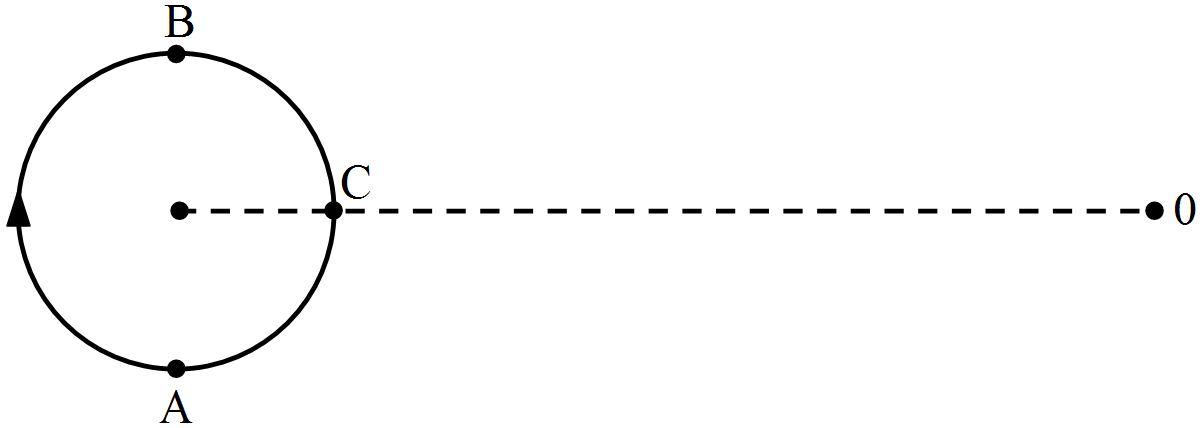
A small source of sound moves on a circle as shown-in figure and an observer is sitting at 0. Let v1, v2, v3 be the frequencies heard when the source is at A, B and C respectively.

  1. v1 > v2 > v3

  2. v1 = v2 > v3

  3. v2 > v3 > v1

  4. v1 > v2 > v2.

Two bodies A and B of equal mass are suspended from two separate massless springs of spring constant k1 and k2 respectively. If the bodies oscillate vertically such that their maximum velocities are equal, the ratio of the amplitude of A to that of B is:

  1. $\frac{\text{k}_1}{\text{k}_2}$

  2. $\sqrt{\frac{\text{k}_1}{\text{k}_2}}$

  3. $\frac{\text{k}_2}{\text{k}_1}$

  4. $\sqrt{\frac{\text{k}_2}{\text{k}^1}}$

The amplitude of the sinusoidally oscillating electric field of a plane wave is 60v/m. Then the amplitude of the magnetic field is:

Two cells, e.m.f. of each is E and internal resistance r are connected in parallel between the resistance R. The maximum energy given to the resistor will be, only when

(a) R = r/2

(b) R = r

(c) R = 2r

(d)  R = 0