MCQ
Impedance of L-R circuit is :
- A$R^{2}+\omega^{2}L^{2}$
- ✓$\sqrt{(R^{2}+\omega^{2}L^{2})}$
- C$R+\omega L$
- D$\sqrt{R+\omega L}$
Generate a complete, print-ready paper with questions like this in minutes — across 16+ boards, with answer keys.
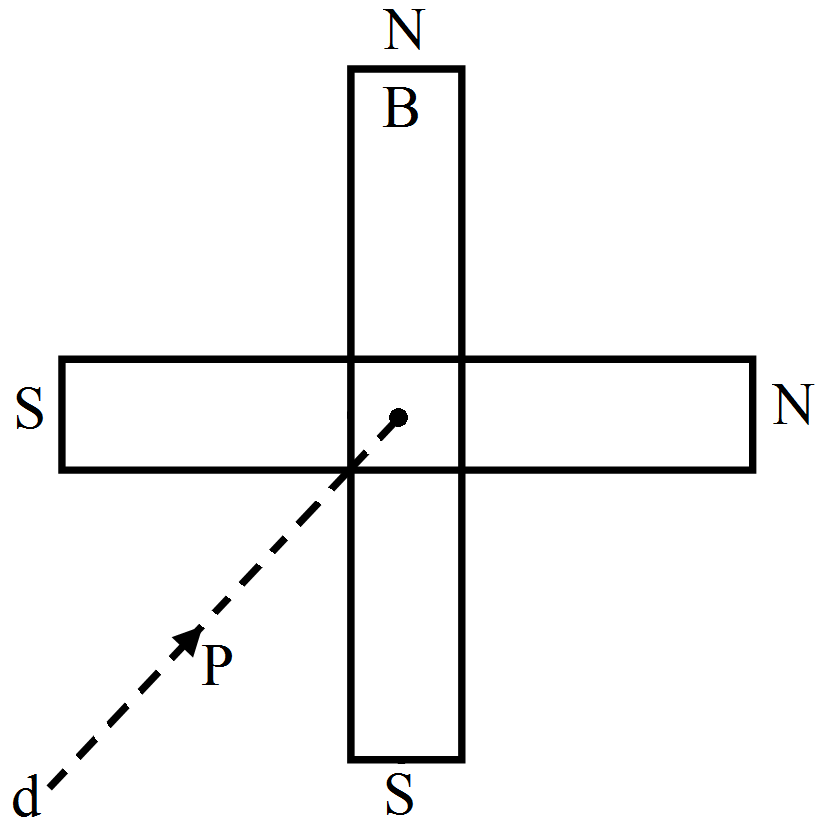
A circular coil of radius 4 cm and of 20 turns carries a current of 3 amperes. It is placed in a magnetic field of intensity of 0.5  . The magnetic dipole moment of the coil is
|
(a) 0.15 |
(b) 0.3 |
(c) 0.45 
|
(d) 0.6
|
An ellipsoidal cavity is carved within a perfect conductor. A positive charge q is placed at the centre of the cavity. The points A and B are on the cavity surface as shown in the figure. Then

|
(a) Potential at A = Potential at B |
|
(b) Total electric field flux through the surface of the cavity is q/ |
|
(c) Electric field near A in the cavity = Electric field near B in the cavity |
|
(d) a, b |
Which of the following is the disadvantage of FM over AM
|
(a) Larger band width requirement |
(b) Larger noise |
|
(c) Higher modulation power |
(d) Low efficiency |
A proton and an α - particle enter a uniform magnetic field perpendicularly with the same speed. If proton takes 25 μ sec to make 5 revolutions, then the periodic time for the α - particle would be
|
(a) 50 μ sec |
(b) 25 μ sec |
(c) 10 μ sec |
(d) 5 μ sec |
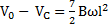
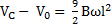
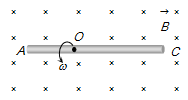
A conducting rod AC of length 4l is rotated about a point O in a uniform magnetic field  directed into the paper. AO = l and OC = 3l. Then
|
(a) |
(b) |
(c) |
(d) |
With the increase in principle quantum number, the energy difference between the two successive energy levels
|
(a) Increases |
|
(b) Decreases |
|
(c) Remains constant |
|
(d) Sometimes increases and sometimes decreases |