MCQ
In $1 L$ saturated solution of $AgCl \left[ K _{ sp }( AgCl )=1.6 \times 10^{-10}\right]$, $0.1$ mol of CuCl $\left[ K _{ sp }( CuCl )=1.0 \times 10^{-6}\right]$ is added. The resultant concentration of $Ag ^{+}$in the solution is $1.6 \times 10^{-x}$. The value of " $x$ " is
  • $7$
  • B
    $8$
  • C
    $9$
  • D
    $2$

Answer

Correct option: A.
$7$
a
It is a case of simultaneous solubility of salts with a common ion. Here, solubility product of CuCl is much greater than that of AgCl , it can be assumed that $Cl ^{-}$in solution comes mainly from CuCl .

$\left[ Cl ^{-}\right]=\sqrt{ K _{ sp }( CuCl )}=10^{-3} M$

Now, for $AgCl , K _{ sp }=1.6 \times 10^{-10}=\left[ Ag ^{+}\right]\left[ Cl ^{-}\right]$

$=\left[ Ag ^{+}\right] \times 10^{-3}$

$\Rightarrow \quad\left[ Ag ^{+}\right]=1.6 \times 10^{-7}$

$\text { Hence, } x=7$

Need a full question paper?

Generate a complete, print-ready paper with questions like this in minutes — across 16+ boards, with answer keys.

Start Generating Free

Similar questions

$0.8\, \mathrm{~g}$ of an organic compound was analysed by Kjeldahl's method for the estimation of nitrogen. If the percentage of nitrogen in the compound was found to be $42\, \%$, then $....\,\mathrm{mL}$ of $1\, \mathrm{M}$ $\mathrm{H}_{2} \mathrm{SO}_{4}$ would have been neutralized by the ammonia evolved during the analysis.
Geometrical shapes of the complexes formed by the reaction of $\mathrm{Ni}^{2+}$ with $\mathrm{Cl}^{-}, \mathrm{CN}^{-}$and $\mathrm{H}_2 \mathrm{O}$, respectively, are
If $m$ and $e$ are the mass and charge of the revolving electron in the orbit of radius $r$ for hydrogen atom, the total energy of the revolving electron will be
The density of a liquid is $1.5\, g/mL$. There are $50\, drops$ in $5\, mL$. The number  of molecules in $1\, drop$ is (molecular weight of liquid is $100$)
Which of the following are not state functions?

$(I)\,\,q + \mathrm{w}$           $(II)\,\, q$

$(III)\,\, \mathrm{w}$              $(IV)\,\, H - TS$

For the system $A_{(g)} + 2B_{(g)}$ $\rightleftharpoons$ $C_{(g)}$, the equilibrium concentrations are $(A) 0.06$ mole/litre $(B) 0.12$ mole/litre $(C) 0.216$ mole/litre. The ${K_{eq}}$ for the reaction is
Monochlorination of ethylbenzene $\left(\mathrm{PhCH}_2 \mathrm{CH}_3\right) $ with $\mathrm{Cl}_2​$ under heat produces $ ..........$
In the isoelectronic species the ionic radii $\mathop A\limits^o $ of $N^{3-}, O^{2-}$ and $F^-$ are respectively given by :-
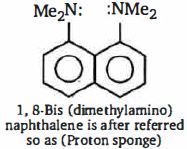
Its basic strength is $10^{10}$ more than $I$ -dimethyl amino naphthalene. Reason for high basic strength is
Product $(C)$ is