MCQ
In $_{88}R{a^{226}}$ nucleus, there are
  • A
    $138$ protons and $88$ neutrons
  • $138$ neutrons and $88$ protons
  • C
    $226$ protons and $88$ electrons
  • D
    $226$ neutrons and $138$ electrons

Answer

Correct option: B.
$138$ neutrons and $88$ protons
b
(b) $_z{X^A}{ = _{88}}R{a^{226}}$

Number of protons $= Z = 88$

Number of neutrons $ = A - Z = 226 - 88 = 138$.

Need a full question paper?

Generate a complete, print-ready paper with questions like this in minutes — across 16+ boards, with answer keys.
Start Generating Free

Similar questions

When a metal surface is illuminated by light of wavelengths $400\; nm$ and $250\; nm$, the maximum velocities of the photoelectrons ejected are $v$ and $2v$ respectively. The work function of the metal is $(h =$ Planck’s constant, $c =$ velocity of light in air)
A particle of mass $m$ and charge $q$ enters a magnetic field $B$ perpendicularly with a velocity $v$, The radius of the circular path described by it will be
The resistance of a coil for dc is in ohms. In ac, the resistance
A ball projected from ground at an angle of $45^o$ just clears a wall in front. If point of projection is $4\,m$ from the foot of wall and ball strikes the ground at a distance of $6\,m$ on the other side of the wall, the height of the walI is  ........ $ m$
Three resistances $4\,\Omega $ each of are connected in the form of an equilateral triangle. The effective resistance between two corners is
The graph which shows the variation of the de Broglie wavelength $(\lambda)$ of a particle and its associated momentum $(p)$ is
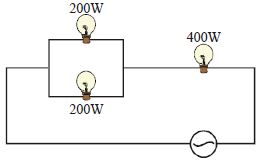
Three electric bulbs of $200\,W,\,\,200\,W$ and $400\,W$ are shown in figure. The resultant power of the combination is ................ $W$
A man can see clearly up to $3$ metres. Prescribe a lens for his spectacles so that he can see clearly up to $12$ metres
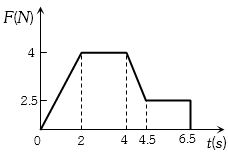
A body of $2\, kg$ has an initial speed $5ms^{-1}$. A force acts on it for some time in the direction of motion. The force time graph is shown in figure. The final speed of the body.  .......... $m{s^{ - 1}}$
Two particles execute $SHM$ of same amplitude of $20\, cm$ with same period along the same line about the same equilibrium position. The maximum distance between the two is $20\, cm.$ Their phase difference in radians is