MCQ
In a biprism experiment using sodium light $\lambda = 6000\, Å$ an interference pattern is obtained in which $20$ fringes occupy $2\, cm$. On replacing sodium light by another source of wavelength $\lambda_2$ without making any other change $30$ fringes occupy $2.7\, cm$ on the screen. What is the value of $\lambda_2$?.......$\mathop A\limits^o $
  • A
    $4500$
  • $5400$
  • C
    $5600$
  • D
    $4200$

Answer

Correct option: B.
$5400$
b

Need a full question paper?

Generate a complete, print-ready paper with questions like this in minutes — across 16+ boards, with answer keys.

Start Generating Free

Similar questions

A bulb of $100$ watt is hanging at a height of one meter above the centre of a circular table of diameter $4\, m$ If the intensity at a point on its rim is ${I_0}$, then the intensity at the centre of the table will be
An ideal gas undergoes a quasi static, reversible process in which its molar heat capacity $C$ remains constant. If during this process the relation of pressure $P$ and volume $V$ is given by $PV^n =$ constant, then n is given by (Here $C_p$ and $C_v$ are molar specific heat at constant pressure and constant volume, respectively) :
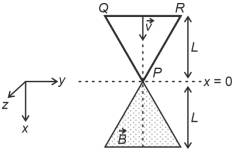
A region in the form of an equilateral triangle (in $x-y$ plane) of height $L$ has a uniform magnetic field $\vec{B}$ pointing in the $+z$-direction. A conducting loop $P Q R$, in the form of an equilateral triangle of the same height $L$, is placed in the $x-y$ plane with its vertex $P$ at $x=0$ in the orientation shown in the figure. At $t=0$, the loop starts entering the region of the magnetic field with a uniform velocity $\vec{v}$ along the $+x$-direction. The plane of the loop and its orientation remain unchanged throughout its motion.

Which of the following graph best depicts the variation of the induced emf $(E)$ in the loop as a function of the distance $(x)$ starting from $x=0$ ?

In the case of bar magnet, lines of magnetic induction
Two separate wires $A$ and $B$ are stretched by $2 \,mm$ and $4\, mm$ respectively, when they are subjected to a force of $2\, N$. Assume that both the wires are made up of same material and the radius of wire $B$ is 4 times that of the radius of wire $A$. The length of the wires $A$ and $B$ are in the ratio of $a : b$. Then $a / b$ can be expressed as $1 / x$ where $x$ is
Assertion : If three capacitors of capacitances $C_1 < C_2 < C_3$ are connected in parallel then their equivalent capacitance $C_P > C_S$.

Reason : $\frac{1}{{{C_p}}} = \frac{1}{{{C_1}}} + \frac{1}{{{C_2}}} + \frac{1}{{{C_3}}}$

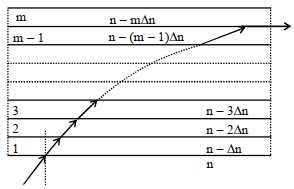
A monochromatic light is travelling in a medium of refractive index $n=1.6$. It enters a stack of glass layers from the bottom side at an angle $\theta=30^{\circ}$. The interfaces of the glass layers are parallel to each other. The refractive indices of different glass layers are monotonically decreasing as $n_m=n-m / n$, where $n_m$ is the

refractive index of the $\mathrm{m}^{\text {th }}$ slab and $\Delta \mathrm{n}=0.1$ (see the figure). The ray is refracted out parallel to the interface between the $(m-1)^{\text {th }}$ and $m^{\text {th }}$ slabs from the right side of the stack. What is the value of $m$ ?

(IMAGE)

In a Young's double slit experiment the angular width of a fringe formed on a distant screen is $1^{\circ}$. The wavelength fo the light used is $6280 \;\mathring A$. $...........\,mm$ is the distance between the two coherent sources.
A balloon contains $1500 \,m^3$ of helium at $27^\circ C$ and $4$ atmospheric pressure. The value of helium at $ - \,3^\circ C$ temperature and $2$ atmospheric pressure will be ...... $m^3$
Consider a point $P$ on the circumference of a disc rolling along a horizontal surface. If $R$ is the radius of the disc, the distance through which $P$ moves in one full rotation of the disc is