In a building there are $15$ bulbs of $45\; \mathrm{W}, 15$ bulbs of $100\; \mathrm{W}, 15$ small fans of $10 \;\mathrm{W}$ and $2$ heaters of $1 \;\mathrm{kW}$. The voltage of electric main is $220\; \mathrm{V}$. The minimum fuse capacity (rated value) of the building will be: .......... $A$
JEE MAIN 2020, Medium
Download our app for free and get started
$220 \mathrm{I}=\mathrm{P}=15 \times 45+15 \times 100+15 \times 10+2 \times 10^{3}$
$I=\frac{4325}{220}=19.66$
$\mathrm{I} \simeq 20 \mathrm{A}$

Download our appand get started for free
Experience the future of education. Simply download our apps or reach out to us for more information. Let's shape the future of learning together!No signup needed.*
Similar Questions
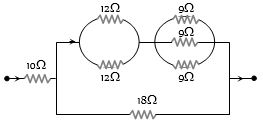
- 1In the following circuit, $18\,\Omega $ resistor develops $2\,J/sec$ due to current flowing through it. The power developed across $10\,\Omega $ resistance is .............. $W$View Solution
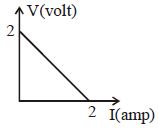
- 2Potential difference across a cell and current through a cell is shown in graph. A battery consists of such identical $40$ cells. Max current supplied by the battery through a load of $2.5\,\Omega $ equal to .............. $A$View Solution
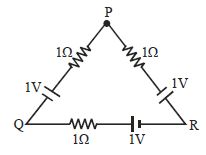
- 3In given circuit find potential difference between $P$ and $Q$ .................. $V$View Solution
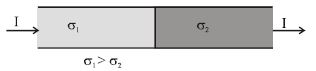
- 4Current $I$ is flowing through the two materials having electrical conductivities $\sigma_1$ and $\sigma_2$ respectively $(\sigma_1 > \sigma_2 )$ as shown in the figure. The total amount of charge at the junction of the materials isView Solution
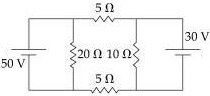
- 5In the circuit shown, current (in $A$) through $50\; V$ and $30\; V$ batteries are, respectivelyView Solution
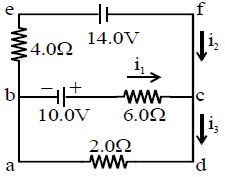
- 6Find the value of current $i_1$ for the circuit shown in figure :- ............ $A$View Solution
- 7A current of $5\, A$ passes through a copper conductor (resistivity $= 1.7\times10^{-8}\,\Omega \,m$) of radius of cross-section $5\, mm$. Find the mobility of the charges if their drift velocity is $1.1\times10^{-3}\, m/s$ ................ $m^2/Vs$View Solution
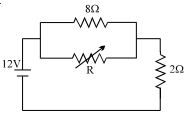
- 8The value of the resistance $R$ in figure is adjusted such that power dissipated in the $2\,\Omega$ resistor is maximum. Under this conditionView Solution
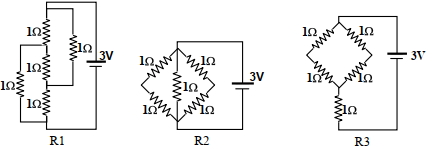
- 9Figure shows three resistor configurations $\mathrm{R} 1, \mathrm{R} 2$ and $\mathrm{R} 3$ connected to $3 \mathrm{~V}$ battery. If the power dissipated by the configuration $\mathrm{R} 1, \mathrm{R} 2$ and $\mathrm{R} 3$ is $\mathrm{P} 1, \mathrm{P} 2$ and $\mathrm{P} 3$, respectively, thenView Solution
Figure:
- 10A wire of resistance $160\,\Omega$ is melted and drawn in wire of one-fourth of its length. The new resistance of the wire will be $......\Omega$View Solution