In a certain murder investigation, it was important to discover whether the victim was long-sighted or short-sighted. How could a detective decide by examining his spectacles?
Download our app for free and get started
- If the victim's spectacles are fitted with convex lens, the detective can conclude that the victim was long-sighted. A person suffering from long-sightedness, or hypermetropia, wears spectacles with convex lenses to correct the defect.
- If the victim's spectacles are fitted with concave lens, the detective can conclude that the victim was short-sighted. A person with short-sightedness, or myopia, wears spectacles with concave lenses to correct the defect.

Download our appand get started for free
Experience the future of education. Simply download our apps or reach out to us for more information. Let's shape the future of learning together!No signup needed.*
Similar Questions
- 1View SolutionWhy does the sky appear blue on a clear day?
- 2View SolutionA person needs a lens of power, -5.5 dioptres for correcting his distant vision. For correcting his near vision, he needs a lens of power, +1.5 dioptres. What is the focal length of the lens required for correcting
- Distant vision, and
- Near vision?
- 3View SolutionWhen we place a glass prism in the path of a narrow beam of white light a spectrum is obtained. What happens when a second identical prism is placed in an inverted position with respect to the first prism? Draw a labelled ray diagram to illustrate it.
- 4View SolutionWhat is atmospheric refraction?What causes atmospheric refraction?
- 5View SolutionIn the figure given below a narrow beam of white light is shown to pass through a triangular glass prism. After passing through the prism it produces a spectrum XY on a screen.
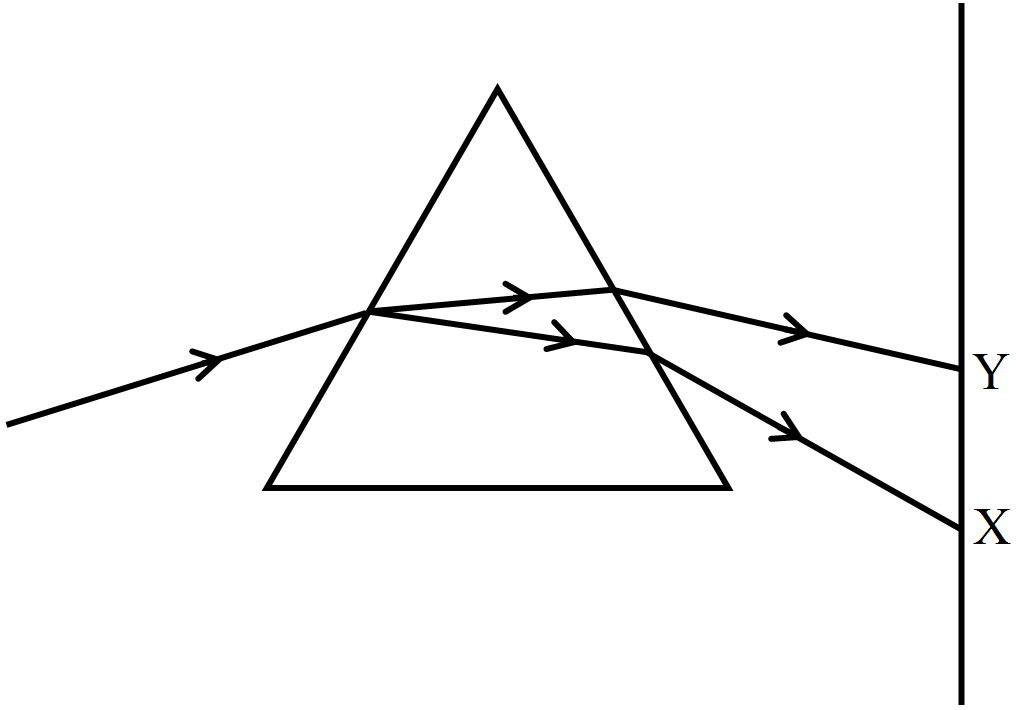
- State the colour seen at X and Y.
- Why do different colours of white light bend through different angles with respect to the incident beam of light?
- 6View SolutionDefine the term power of accommodation. Write the modification in the curvature of the eye lens which enables us to see the nearby objects clearly?
- 7View SolutionWhen a light ray passes obliquely through the atmosphere in an upward direction how does its path generally change?
- 8View SolutionA narrow beam of light produces a spectrum XY on passing through a triangular glass prism.
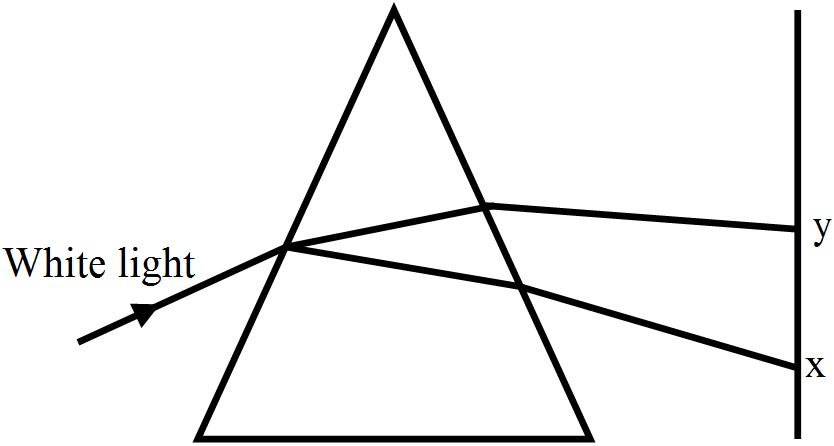
- State the colour at X and Y.
- Why do the different components of white light bend through different angles with respect to the incident beam of light?
- 9View SolutionWhy do stars twinkle?
- 10View SolutionFive persons A, B, C, D and E have diabetes, leukaemia, asthma, meningitis and hepatitis, respectively.
- Which of these persons can donate eyes?
- Which of these persons cannot donate eyes?